
Fixed vs Adjustable Rate Mortgage: What’s Better in 2026?
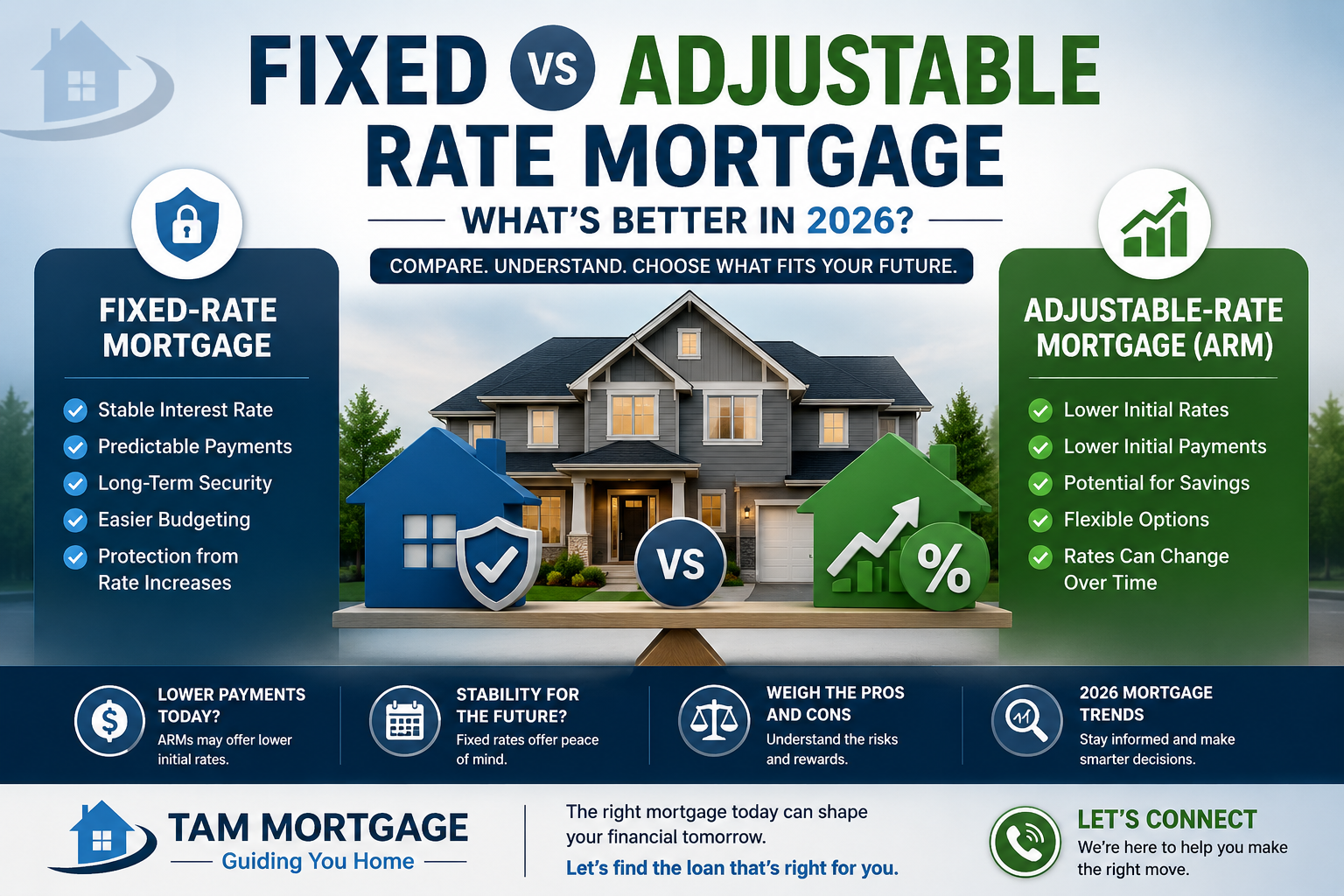
Buying a home in 2026 means navigating one of the most consequential financial decisions of your life — and it starts with choosing the right mortgage. With the 30-year fixed rate hovering around 6.36% and the 5/1 ARM averaging roughly 5.79%, many buyers are taking a second look at adjustable-rate mortgages (ARMs) as an affordability strategy. But lower starting rates come with trade-offs, and understanding them is critical before you sign.
This guide breaks down fixed vs adjustable mortgage options, compares their pros, cons, and risks, and examines 2026 mortgage trends to help you make a well-informed decision about which loan structure fits your financial goals.
What Is a Fixed-Rate Mortgage?
A fixed-rate mortgage loan locks in your interest rate for the entire life of the loan. Whether you choose a 15-year or 30-year term, your principal and interest payment never changes — regardless of what the broader market does.
The most common fixed mortgage options are:
- 30-year fixed: Lower monthly payments spread over a longer term
- 15-year fixed: Higher payments, but significantly less interest paid overall
Main Benefits of Fixed Mortgages
- Payment stability: You know exactly what you’ll owe every month, for every year of the loan
- Easier long-term budgeting: No surprises tied to market fluctuations
- Protection from rate increases: If rates rise — as they have in recent years — your payment stays the same
What Is an Adjustable-Rate Mortgage (ARM)?
An adjustable-rate mortgage begins with a fixed introductory rate for a set number of years, then adjusts periodically based on a financial index plus a lender margin. That initial period is typically where ARMs shine — offering rates lower than what you’d get with a fixed loan.
Common ARM structures include:
- 5/1 ARM: Fixed for 5 years, then adjusts annually
- 7/1 ARM: Fixed for 7 years, then adjusts annually
- 10/1 ARM: Fixed for 10 years, then adjusts annually
After the fixed period ends, your rate is recalculated using an index (such as SOFR) plus your lender’s margin, subject to adjustment caps that limit how much your rate can move at any one time or over the life of the loan.
Fixed vs Adjustable Mortgage — Key Differences
Feature | Fixed-Rate Mortgage | Adjustable-Rate Mortgage |
|---|---|---|
Interest Rate | Stays constant for life of loan | Changes after initial fixed period |
Monthly Payment | Predictable and stable | May increase or decrease over time |
Initial Interest Rate | Usually higher | Usually lower |
Risk Level | Lower risk | Higher uncertainty |
Best For | Long-term homeowners | Short-term or flexible ownership |
Rate Flexibility | Limited | Potential short-term savings |
Adjustable Rate Mortgage Pros and Cons
Pros of ARMs
- Lower initial interest rates than comparable fixed loans
- Reduced early monthly payments, improving short-term cash flow
- Potential for savings if market rates decline after the fixed period
- Well-suited for buyers who plan to sell or refinance before the adjustment period begins
Cons of ARMs
- Future payment uncertainty once the fixed period ends
- Risk of rising rates — especially in volatile economic conditions
- Budget instability that makes long-term financial planning harder
- Psychological stress tied to unpredictable rate movements
Fixed Mortgage Pros and Cons
Pros
- Stable monthly payments throughout the loan term
- Straightforward long-term financial planning
- Peace of mind, especially for families on fixed incomes or tight budgets
- Full protection from market volatility and rate hikes
Cons
- Higher initial interest rates compared to ARM introductory rates
- Less flexibility if market rates fall significantly after you lock in
- Potentially higher early payments if a lower ARM rate was available
Mortgage Trends in 2026 — Why Buyers Are Reconsidering ARMs
The mortgage market in 2026 reflects a prolonged elevated-rate environment. The 30-year fixed rate is averaging around 6.36%, according to Freddie Mac, while the national average 5/1 ARM sits near 5.79%. That gap — roughly half a percentage point — can translate into meaningful savings on monthly payments, especially for buyers stretching affordability limits.
Affordability remains the defining concern for today’s homebuyers. Rising home prices combined with rates well above pandemic-era lows have pushed many buyers to explore ARMs as a way to lower their initial monthly obligation. Some are betting on future rate cuts or refinancing opportunities, while others simply need a lower payment today to qualify for the home they want.
Strategically, buyers are choosing ARMs for three main reasons: they expect income to grow over time, they plan to move before the adjustment period kicks in, or they anticipate refinancing into a fixed rate if market conditions improve. There has also been a notable uptick in ARM usage for larger “jumbo” loans, where even a small rate difference has an outsized dollar impact.
When a Fixed-Rate Mortgage Makes More Sense
A fixed-rate mortgage is typically the stronger choice if you:
- Plan to stay in the home for 10 or more years
- Want predictable, stable monthly payments for household budgeting
- Are concerned about rate volatility or further market increases
- Prefer peace of mind over potentially lower short-term costs
- Have a family or fixed income where payment surprises would cause strain
When an Adjustable-Rate Mortgage May Be Better
An ARM may be the smarter choice if you:
- Plan to sell or move within five to seven years
- Expect to refinance before the adjustment period begins
- Need a lower initial payment to comfortably qualify for a home loan today
- Are comfortable with some financial risk and have the reserves to handle rate changes
- Are purchasing a larger loan amount where the rate difference creates significant savings
ARM vs Fixed Mortgage — Monthly Payment Comparison
To put the numbers in perspective, here’s a side-by-side scenario on a $400,000 home loan:
30-Year Fixed (6.5%) | 5/1 ARM (5.79%) | |
|---|---|---|
Monthly Payment | ~$2,528 | ~$2,349 |
Annual Payment | ~$30,336 | ~$28,188 |
5-Year Savings | — | ~$10,740 |
After Year 5 | Rate stays at 6.5% | Rate may adjust higher |
The ARM saves roughly $179 per month during the initial five-year fixed window — nearly $10,740 in total. However, if rates rise significantly after year five, that advantage can erode quickly. This example underscores why the question is never just about today’s rate, but about your entire financial timeline.
Questions Homebuyers Should Ask Before Choosing a Mortgage
Before you commit to either loan type, work through these key questions:
- How long do you realistically plan to stay in the home?
- Can your budget absorb a payment increase of $200–$400/month if your ARM adjusts upward?
- Do current economic signals suggest rates are more likely to fall or rise in the next five years?
- Will refinancing be realistic for you — given future income, credit, and market conditions?
- Do you prioritize long-term stability, or do you need maximum affordability right now?
There are no universally correct answers. The best mortgage is the one that aligns with your actual circumstances, not a generalized rule.
How TAM Mortgage Helps Buyers Compare Loan Options
Choosing between a fixed and adjustable mortgage isn’t just a rate comparison — it’s a financial planning conversation. TAM Mortgage specializes in helping buyers work through exactly these decisions. Their team can help you:
- Run side-by-side scenarios comparing ARM vs fixed mortgage payments over different time horizons
- Understand the real cost of rate adjustments and how caps protect — or limit — your exposure
- Evaluate whether refinancing is a realistic part of your long-term plan
- Choose a loan structure that reflects your income trajectory, risk tolerance, and ownership timeline
Whether you’re a first-time buyer weighing affordability or a move-up buyer looking at long-term cost optimization, having an expert in your corner makes the decision clearer and less stressful.
Conclusion
Fixed-rate mortgages offer stability, predictability, and long-term peace of mind — particularly valuable in a market where rate direction is uncertain. Adjustable-rate mortgages, by contrast, can offer meaningful short-term savings and lower initial payments, but come with the risk of future payment increases once the fixed period ends.
In 2026, the right choice isn’t determined by which type sounds better in theory — it depends on how long you plan to stay in the home, what your budget can realistically handle, and whether you have a credible plan for when the rate eventually adjusts.
Not sure whether a fixed or adjustable mortgage is right for you in 2026? Contact TAM Mortgage to compare loan options, run the numbers on both scenarios, and understand the long-term financial impact before making a decision.