
Renting vs Buying in 2026: Which Is the Better Financial Move?
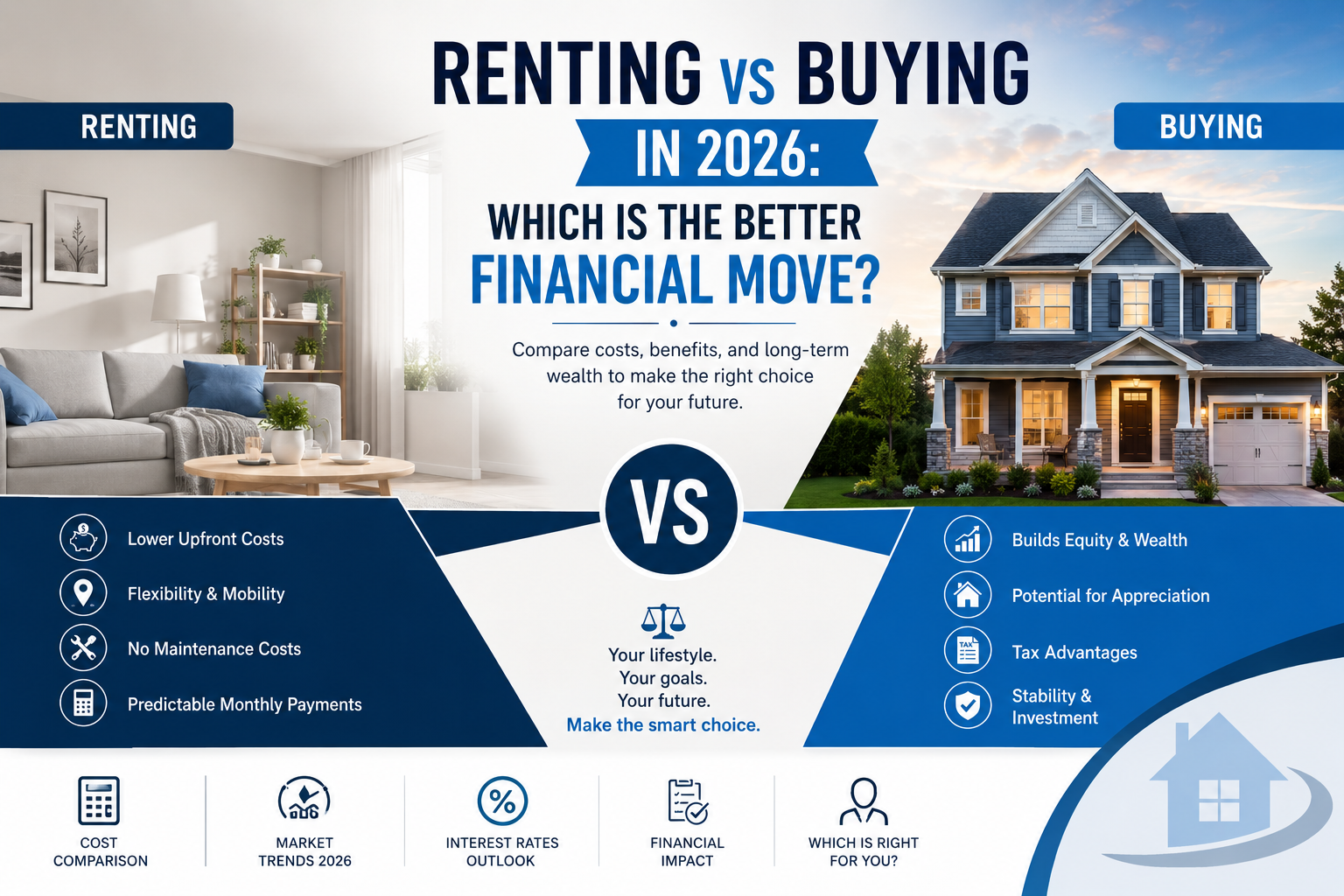
The decision to rent or buy a home has never been more complicated — or more consequential. In 2026, rising home prices, mortgage rates hovering above 6%, and persistent inflation have forced millions of Americans to rethink what was once a straightforward path to the “American Dream.” Whether you’re a first-time buyer weighing your options or a long-term renter wondering if now is finally the time to buy, this guide breaks down the real numbers, the hidden costs, and the personal factors that should drive your decision.
So — should you rent or buy in 2026? The honest answer depends on where you live, how long you plan to stay, and the state of your finances. Let’s dig in.
Understanding the Housing Market in 2026
The real estate market in 2026 is caught between cautious optimism and persistent affordability pressure. Mortgage rates peaked at over 7% in early 2025 before easing back to roughly 6–6.2% by mid-2026. The Mortgage Bankers Association, Redfin, and the National Association of Realtors all project rates holding in the 6%–6.5% range for the near term, with a sustained dip below 6% unlikely until 2027.
Home prices, meanwhile, continue to rise modestly. Housing supply remains 3–4 million units below demand nationally, and the so-called “lock-in effect” — where existing homeowners sit tight on 3% mortgages and refuse to sell — keeps inventory constrained. Annual home price appreciation is running at approximately 3.9%, meaning waiting a year to buy a $400,000 home effectively costs you an extra $15,600 on the purchase price alone.
On the rental side, tenants aren’t catching a break either. Insurance costs alone rose 6.9% year-over-year in early 2026, and rents in most major metros have continued their upward march. The balance between renting and buying has genuinely shifted compared to even three years ago, and the math now looks meaningfully different depending on your specific market.
The Financial Benefits of Renting
Despite the conventional wisdom that renting is “throwing money away,” it carries real financial advantages in the current environment — especially in expensive coastal markets.
Lower upfront costs. Renting typically requires one to three months of rent as a security deposit. Buying, by contrast, demands a down payment (often 10–20% of the purchase price), closing costs of 2–5%, and immediate reserves for repairs. On a $400,000 home, that’s a $40,000–$80,000 outlay before you even move in.
Flexibility. If your career, family situation, or lifestyle is likely to change within the next few years, renting preserves your ability to relocate without the transaction costs of selling a home. Real estate commissions and closing fees typically run 8–10% of a home’s value, which can easily wipe out years of equity growth on a short hold.
Predictable monthly payments. A fixed lease eliminates the budget-busting surprises that homeowners face — burst pipes, failing HVAC systems, or a new roof can easily cost $10,000–$30,000. Renters simply call the landlord.
Reduced maintenance burden. This is both a financial and a time benefit. Homeownership analysts frequently cite an average annual maintenance cost of 1–2% of a home’s value. On a $400,000 property, that’s $4,000–$8,000 per year, or $333–$667 per month — an expense renters simply don’t carry.
Easier budgeting. Without property taxes, HOA fees, or unexpected repair bills folded into your monthly obligations, renters can plan their finances with greater precision.
The Financial Benefits of Buying a Home
For all the advantages of renting, homeownership still builds wealth in ways that renting structurally cannot.
Equity accumulation. Every mortgage payment you make reduces your loan balance and increases your ownership stake in the property. Over a 30-year mortgage, a borrower on a $400,000 home will have paid the property off entirely — something no amount of rent payments can accomplish.
Property appreciation. National home prices have appreciated at roughly 3–4% annually over the long run. In high-demand markets, that growth has often far exceeded the stock market. Even at modest rates, appreciation substantially magnifies total return when you factor in leverage — you gain on the full property value while only putting down a fraction of it.
Tax advantages. Homeowners can deduct mortgage interest and property taxes on their federal returns (subject to limits), and the capital gains exclusion — up to $250,000 for single filers and $500,000 for couples on a primary residence sale — is one of the most powerful tax benefits available to ordinary Americans.
Stability and predictability. A 30-year fixed mortgage locks in your principal and interest payment for three decades. Renters, by contrast, face lease renewals and potential double-digit annual rent increases.
Forced savings. Many people find it easier to build wealth through homeownership because the equity accumulation is automatic — every payment is, in part, savings. Renters who plan to invest the difference between rent and a mortgage payment rarely follow through consistently.
Cost Comparison — Renting vs Buying in 2026
Here’s where the rubber meets the road. For a $400,000 home with a 20% down payment at a 6.5% mortgage rate, the all-in monthly cost of ownership — including principal, interest, property taxes, insurance, and a maintenance reserve — typically runs $3,200–$3,600 per month. A comparable rental in the same market often runs $2,200–$2,500.
That’s a monthly premium of $700–$1,100 to own rather than rent. At the same time, a portion of every mortgage payment builds equity, and appreciation adds long-run value that rent payments never do.
Key costs to compare:
Cost Category | Renter | Buyer |
Monthly payment | $2,200–$2,500 (rent) | $2,100–$2,400 (P&I only) |
Upfront costs | 1–3 months deposit | 10–25% of home price |
Maintenance | $0 (landlord’s problem) | 1–2% of value annually |
Property taxes | $0 | 0.5–2.5% of value annually |
Insurance | $15–$30/month (renters) | $150–$300/month (homeowners) |
HOA fees | Often included in rent | $0–$500+/month |
Equity built | $0 | Grows with every payment |
Opportunity cost matters too. A 20% down payment on a $400,000 home is $80,000. Invested in a diversified index fund earning 10% annually (the S&P 500’s long-run average), that $80,000 could grow to roughly $207,000 over 10 years. However, the leveraged nature of real estate — combined with appreciation and principal paydown — often matches or exceeds this in practice, particularly in growing markets.
When Renting Makes More Sense
Renting is the smarter financial move in several specific situations:
Short-term plans. If you expect to move within three to five years, buying is almost never worth it. Transaction costs alone — agent commissions, closing fees, title insurance — can consume 8–10% of a home’s value. You need sufficient appreciation and equity just to break even on a short hold.
High-cost markets. In cities like San Francisco, New York, or Seattle, price-to-rent ratios are so extreme that renting and investing the difference often produces better long-term outcomes. Financial calculators consistently show that in these markets, buying makes sense only for stays exceeding seven to ten years.
Unstable income. A mortgage is an inflexible, long-term obligation. If your income is variable, you’re self-employed with irregular revenue, or your job security is uncertain, renting buys you financial resilience that ownership cannot.
High interest rate environments. With rates at 6%+ in 2026, the cost of carrying a mortgage is substantially higher than it was three to four years ago. Waiting for rates to decline — and then refinancing — can save hundreds of dollars per month on a large loan.
Career flexibility. Remote work has created enormous optionality for workers who aren’t tied to a specific city. Renting preserves your ability to chase opportunities, follow lower costs of living, or simply change your mind.
When Buying Makes More Sense
The case for buying is equally compelling under the right conditions.
Long-term settlement plans. If you intend to stay in an area for at least seven to ten years, time is on your side. Equity builds, appreciation compounds, and the transaction costs become a smaller and smaller fraction of your total investment.
Stable income and sufficient savings. Lenders generally want to see 28% or less of your gross income going to housing costs (PITI: principal, interest, taxes, and insurance). If you can comfortably meet this threshold — and still maintain three to six months of emergency savings after your down payment — you’re in a strong position to buy.
Favorable local markets. In 57.7% of U.S. counties, homeownership is currently cheaper than renting on a monthly basis, according to Attom’s 2026 Rental Affordability Report. This is especially true across the Midwest and South. If you live in or are open to these markets, the monthly cost advantage for buyers is real and immediate.
Family stability. Beyond the numbers, the stability of homeownership — fixed address, enrollment in a school district, the ability to customize your space — has real value for families with children that doesn’t always show up in financial spreadsheets.
Wealth-creation goals. For buyers in Sun Belt and fast-growing inland markets, a 10-year study by AD Mortgage modeling outcomes in 250 U.S. cities found that long-run home equity advantages favor buyers despite higher short-term monthly costs in many of these regions.
Hidden Costs People Forget About
Both sides of this decision come with costs that rarely show up in the headline comparison.
For Buyers:
- Closing costs: Typically 2–5% of the purchase price, paid upfront and largely non-recoverable.
- Repairs and maintenance: Budget $4,000–$8,000 per year on a $400,000 home. New homeowners frequently underestimate this.
- Property taxes: These vary dramatically by state and locality — from under 0.5% annually in Hawaii and Alabama to over 2% in New Jersey and Illinois.
- Homeowners insurance: Premiums have surged in recent years, particularly in climate-risk areas. Budget $150–$300/month in most markets.
- HOA fees: In condos and planned communities, these can run $200–$600/month — and they tend to rise over time.
For Renters:
- Annual rent increases: Even modest 3–5% annual increases add up dramatically over a decade. A $2,000 rent that rises 4% per year costs $2,960 in year 10.
- Security deposits: Upfront cash tied up with no return on investment.
- Limited customization: You cannot renovate, repaint, or modify without landlord approval — a real constraint for long-term renters.
- No equity growth: A decade of rent payments, at $2,500/month, totals $300,000 — with zero residual value to show for it.
Renting vs Buying Based on Your Lifestyle
There is no universal right answer. Your life stage and priorities should heavily shape this decision.
Young professionals in their 20s and early 30s often benefit most from renting: maximum career flexibility, no maintenance burden, and the freedom to live in desirable (expensive) urban areas without the commitment of ownership. That said, those who can afford to buy early and stay put for a decade will likely be glad they did.
Families with children frequently tilt toward buying. School district stability, the ability to customize a home, and the value of putting down roots in a community make ownership appealing even if the pure financial case is close.
Retirees face a unique calculus. Those who own their homes outright benefit from eliminated housing costs in retirement. Those still renting face the risk of rent increases on a fixed income. However, tying up significant capital in a home also carries opportunity costs for retirees who need liquidity.
Remote workers have unlocked perhaps the most interesting opportunity in the current market: the ability to relocate to lower-cost markets where buying is clearly cheaper than renting. In many Midwest and Southeast counties, a monthly mortgage on a median-priced home consumes well under 20% of median wages.
Investors should think about price-to-rent ratios carefully. Markets where homes sell for less than 15 times annual rent are generally favorable for buyers; those above 20 times annual rent often favor renting and investing the difference.
How Mortgage Rates Affect the Buy vs Rent Decision
Mortgage rates are the single biggest variable in the 2026 rent-vs-buy equation. At 6%, a $320,000 loan (80% of a $400,000 purchase) carries a monthly principal and interest payment of about $1,919. At 7%, that same loan costs $2,129/month — a $210/month difference, or $2,520/year.
This is why many experts now advocate the “date the rate, marry the house” strategy: buy a home you plan to hold long-term at today’s rates, then refinance when rates decline. If rates fall to 5.5% — projected by some analysts for late 2026 or early 2027 — refinancing a $400,000 loan could save approximately $180/month.
Fixed vs adjustable-rate mortgages (ARMs): ARMs offer lower introductory rates — sometimes 50–75 basis points below fixed rates — in exchange for rate variability after an initial period (typically five or seven years). For buyers confident they’ll sell or refinance before the adjustment period, an ARM can meaningfully reduce upfront carrying costs. For buyers planning to stay long-term, a fixed rate offers certainty and protection against future rate increases.
The cost of waiting: On a $400,000 home appreciating at 3.9% annually, waiting one year to buy means the home costs $15,600 more — and you’ve paid rent in the meantime. Total cost of a one-year delay: approximately $40,600 in combined price appreciation and rent paid.
Long-Term Wealth Comparison: Renting vs Buying
Over a 10–30 year horizon, the wealth outcomes of renting versus buying can diverge dramatically — but the direction depends heavily on assumptions and location.
Homeowner scenario: A buyer who purchases a $400,000 home with 20% down, holds it for 10 years, and sees 3.9% annual appreciation ends up with a property worth roughly $590,000 — and approximately $200,000 in equity after paying down the loan. Total return on the $80,000 invested: approximately 250%.
Renter scenario: A renter who invests that same $80,000 down payment in the stock market at 10% annually ends up with about $207,000 after 10 years — a respectable return, but one that requires consistent discipline and no lifestyle spending of the savings.
In practice, the homeowner benefits from leverage (gaining on the full property value), the forced savings mechanism of a mortgage, and the tax exclusion on capital gains at sale. The renter benefits from flexibility, lower carrying costs, and liquidity. Neither outcome is inherently superior; both require discipline and good market conditions.
The emerging consensus from 2026 research is that buyers in high-growth Sun Belt and inland markets are likely to come out ahead over a decade, while renters in high-cost coastal metros who invest their savings diligently can achieve comparable outcomes.
Key Questions to Ask Before Deciding
Before making one of the largest financial decisions of your life, work through these fundamental questions honestly.
- How long will you stay? The single most important variable. If the answer is less than five years, the transaction costs of buying rarely pencil out. Seven-plus years and buying almost always makes sense financially.
- Can you afford the total cost — not just the mortgage? Add up your projected mortgage payment, property taxes, insurance, HOA fees, and a maintenance reserve. Financial advisors recommend keeping total housing costs below 28% of gross monthly income.
- Do you have emergency savings beyond your down payment? Buying a home can leave buyers “house poor” — cash-strapped after closing. You need three to six months of expenses in reserve on top of your down payment and closing costs.
- Is the local market favorable for buyers or renters? In 57.7% of U.S. counties, buying is currently cheaper on a monthly basis. Research your specific market’s price-to-rent ratio before deciding.
- What are your long-term financial and life goals? Homeownership builds equity and stability. Renting preserves flexibility and liquidity. Neither is universally better — the right choice depends on the life you’re building.
Final Verdict — Is Renting or Buying Better in 2026?
Here’s the honest answer: it depends — but there are clear patterns.
Buying is likely the better financial move if you plan to stay at least seven years, live in or are open to the Midwest or Southeast, have stable income, maintain adequate savings, and can lock in a mortgage payment that is close to local rents. The long-run equity and appreciation advantages are real and substantial.
Renting is likely the better financial move if you live in a high-cost coastal market, plan to move within five years, have an unstable income, or are waiting for rates to decline before committing. The flexibility premium and lower carrying costs are genuine advantages, not just excuses.
What 2026 has made clearer than ever is that the old binary — “buying is always better” — was always a oversimplification. Both paths can lead to financial health with the right strategy, the right market, and the right personal circumstances.
The decision is not one-size-fits-all. It is one-size-fits-you.
Conclusion
Whether renting or buying is the right move for you in 2026 comes down to three things: your finances, your lifestyle, and your local market. There is no universally correct answer, but there is a correct answer for your specific situation — and finding it requires honest analysis rather than cultural assumptions.
Take the time to run your own numbers, research your local price-to-rent ratio, and consider how long you realistically plan to stay. Then make the decision based on evidence, not pressure.
Ready to take the next step? Speak with a mortgage expert to understand which option fits your financial future best — a clear-eyed professional assessment of your situation is worth far more than any general guide.