
30-Year Fixed Loan
Not too long ago, applying for a mortgage meant collecting a mountain of paperwork, waiting weeks for an underwriter to review your file, and hoping nothing fell through the cracks. The process was slow, manual, and frankly, frustrating for everyone involved — borrowers and lenders alike.
That’s changing fast.
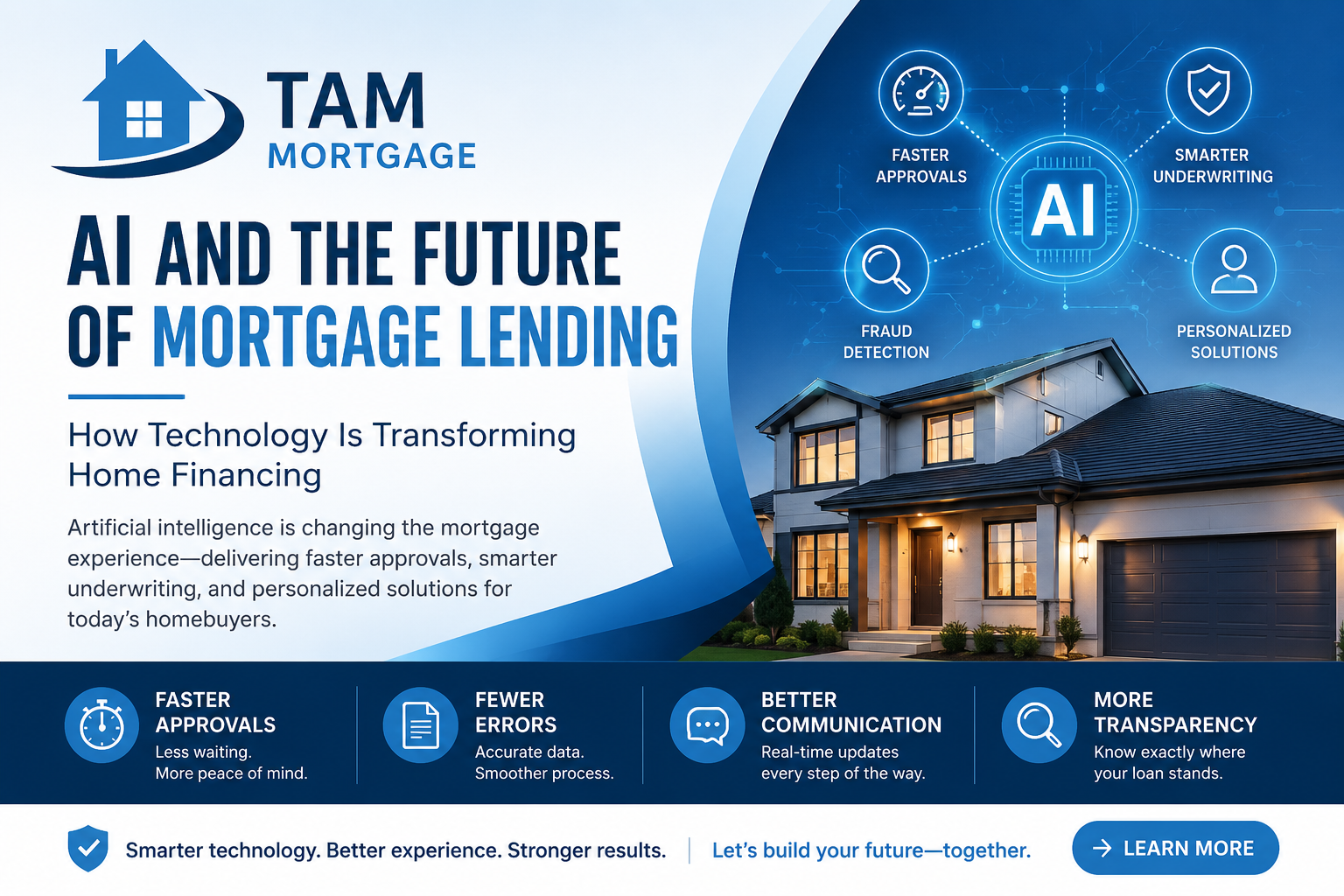
Artificial intelligence is quietly reshaping how mortgages are processed, approved, and serviced. And while most homebuyers don’t think about what’s happening behind the scenes when they submit a loan application, the technology powering that process has gotten dramatically more sophisticated. As someone who works in this industry every day, I can tell you: the changes aren’t just cosmetic. AI is making the mortgage experience genuinely better — faster decisions, fewer errors, and smarter matching between borrowers and loan products.
Here’s what you actually need to know.
What AI in Mortgage Lending Really Means
Artificial intelligence, at its core, is software that learns from data. In lending, that means systems trained on millions of loan applications, borrower profiles, property records, and economic indicators — all to identify patterns that humans would take weeks to spot, if they spotted them at all.
Machine learning, a subset of AI, allows these systems to continuously improve as they process more data. It’s not magic, and it’s not science fiction. It’s pattern recognition at a scale and speed that no human team can match.
The mortgage industry was already moving toward digital platforms — online applications, e-signatures, automated document uploads — before AI entered the picture. What AI adds on top of that infrastructure is intelligence: the ability to analyze, evaluate, and make recommendations in real time, rather than just collecting data and waiting for a human to review it.
Where AI Is Actually Making a Difference
Faster Application Processing
Traditional mortgage processing involves a lot of people touching the same file at different stages — someone verifying income documents, someone else cross-checking employment records, another person pulling credit history. It’s sequential, and delays compound quickly.
AI compresses that timeline dramatically. Automated document collection tools can scan, categorize, and flag incomplete paperwork within minutes. Data verification that once took days — confirming income, employment, and assets — can now happen in near real time by pulling directly from verified data sources. Borrowers spend less time chasing down documents, and processors spend less time doing work that software can handle reliably.
Smarter Underwriting
Underwriting is where AI has arguably the biggest impact. Traditional underwriting relies on a standardized checklist: credit score, debt-to-income ratio, loan-to-value ratio. These are important metrics, but they’re a blunt instrument. They don’t capture the full picture of a borrower’s financial stability.
AI-driven underwriting can analyze a much broader data set — payment history patterns, cash flow trends, employment tenure, even macroeconomic signals — to build a more nuanced picture of risk. For borrowers who don’t fit neatly into traditional boxes (self-employed individuals, those with non-traditional income sources, or first-time buyers with thin credit files), this can be genuinely meaningful. A more complete analysis means fewer qualified borrowers get turned away because one metric didn’t meet a rigid threshold.
Fraud Detection
Mortgage fraud is a real and costly problem — inflated income documents, misrepresented property values, identity theft. AI systems trained on historical fraud cases can flag inconsistencies in documentation that a human reviewer might miss, especially under high application volumes. The patterns are subtle: a slight formatting difference in a pay stub, an address that doesn’t match tax records, a credit profile that changed suspiciously fast before application. AI catches these signals earlier and more consistently.
Personalized Loan Matching
This one is underappreciated. Rather than presenting a borrower with a generic list of loan products, AI-powered platforms can analyze a borrower’s specific financial profile and match them with the programs best suited to their situation — whether that’s a conventional loan, an FHA product, a VA loan, or a specialty program. That kind of matching used to depend entirely on the knowledge and attentiveness of the individual loan officer. AI makes it systematic and data-driven.
What This Means for Borrowers
The benefits of AI in mortgage lending aren’t abstract — they show up in real, tangible ways for people buying or refinancing a home.
Faster approvals. What used to take 30–45 days from application to closing is getting compressed. AI doesn’t eliminate the timeline entirely, but pre-approvals that once took days can now happen in hours.
Fewer errors. Manual data entry is one of the biggest sources of delays and re-work in mortgage processing. When AI handles data extraction and verification, the error rate drops significantly — which means fewer calls asking you to re-submit documents you already sent.
Better communication. AI-powered platforms can provide real-time status updates, flag when action is needed, and answer common borrower questions through intelligent chat interfaces — without making you wait on hold.
More transparency. Borrowers can track exactly where their loan is in the process, rather than sending emails into a void and hoping for a response.
Benefits for Lenders (Which Eventually Benefit You, Too)
When lenders operate more efficiently, that has downstream benefits for borrowers. Lower processing costs can translate to more competitive rates. Faster cycle times mean less risk of rate lock expirations. Better risk assessment means lenders can confidently serve borrowers they might have previously declined.
AI also helps lenders manage compliance more effectively. Mortgage lending is one of the most heavily regulated industries in the country, and keeping up with regulatory requirements is a significant operational burden. Automated compliance checks reduce the risk of errors that can create problems for both lenders and borrowers.
The Honest Limitations
AI in mortgage lending is genuinely useful, but it’s worth being clear-eyed about where the challenges are.
Algorithmic bias is a real concern. If an AI system is trained on historical lending data that reflects past discrimination, it can perpetuate those patterns — denying loans to qualified borrowers in ways that correlate with race or geography, even without explicit discriminatory intent. Regulators are paying close attention to this, and responsible lenders should be too.
Data privacy is another legitimate concern. AI systems require access to sensitive financial information. The security of that data matters, and borrowers should understand how their information is being used and protected.
Regulatory complexity means AI can’t simply automate lending decisions — there are strict fair lending laws and disclosure requirements that govern how credit decisions are made. AI supports the process; it doesn’t replace the regulatory framework.
And then there’s the simple reality that some mortgage scenarios are genuinely complex in ways that require human judgment — a unique property, an unusual income structure, a borrower navigating a major life transition. No algorithm handles nuance the way an experienced loan officer does.
Will AI Replace Mortgage Loan Officers?
Probably not — and here’s why that’s actually the right outcome.
The best mortgage lending isn’t purely a data problem. It’s a guidance problem. People making one of the largest financial decisions of their lives need more than an algorithm to tell them what they qualify for. They need someone who can explain their options, help them think through the trade-offs, and advocate for them when a file hits a snag.
AI is an exceptional tool for handling the mechanical parts of the mortgage process — data gathering, document verification, initial risk scoring. What it can’t replace is the judgment of someone who has worked through hundreds of complicated loan scenarios, or the trust that builds when a loan officer genuinely takes ownership of your file.
The lenders getting this right are using AI to handle what AI does well, so their human team can focus on what humans do better: complex decisions, relationship building, and personalized guidance.
What’s Coming Next
The AI applications already deployed in mortgage lending are just the beginning. Looking ahead, a few trends are worth watching:
Real-time mortgage approvals — fully automated decisions for straightforward borrower profiles — are already emerging for some loan types, and will likely become more common as AI models mature.
Predictive borrower analytics will allow lenders to identify the right time to reach out to borrowers about refinancing opportunities, based on rate movements and individual financial profiles.
Voice-powered mortgage assistance — think AI that can walk you through a mortgage application in a natural conversation — is developing rapidly.
Blockchain integration could eventually allow property records, title history, and financial verifications to be accessed and authenticated instantly, removing some of the most time-consuming steps from the closing process.
How TAM Mortgage Approaches Technology
At TAM Mortgage, we’re not interested in technology for its own sake. We use the tools that make the experience better for our borrowers — faster processing, more accurate reviews, clearer communication — while keeping experienced mortgage professionals front and center in every transaction.
The borrowers we work with across Texas are navigating decisions that matter enormously to their financial futures. That deserves more than an algorithm. It deserves someone who knows the products, understands the market, and can help them find the loan that actually fits their life.
Technology helps us do that more efficiently. It doesn’t do it for us.
Looking for a modern mortgage experience backed by real expertise? TAM Mortgage combines innovative technology with personalized guidance to help you secure the right home loan with confidence. Contact us today at www.tammortgage.com to get started.
TAM Mortgage is a Texas-based mortgage lender offering competitive home loan and refinance solutions. Our team specializes in combining modern lending technology with the personalized expertise that complex financial decisions require.