
Staying Compliant with TRID and TILA Updates: Latest Changes Every LO Should Know
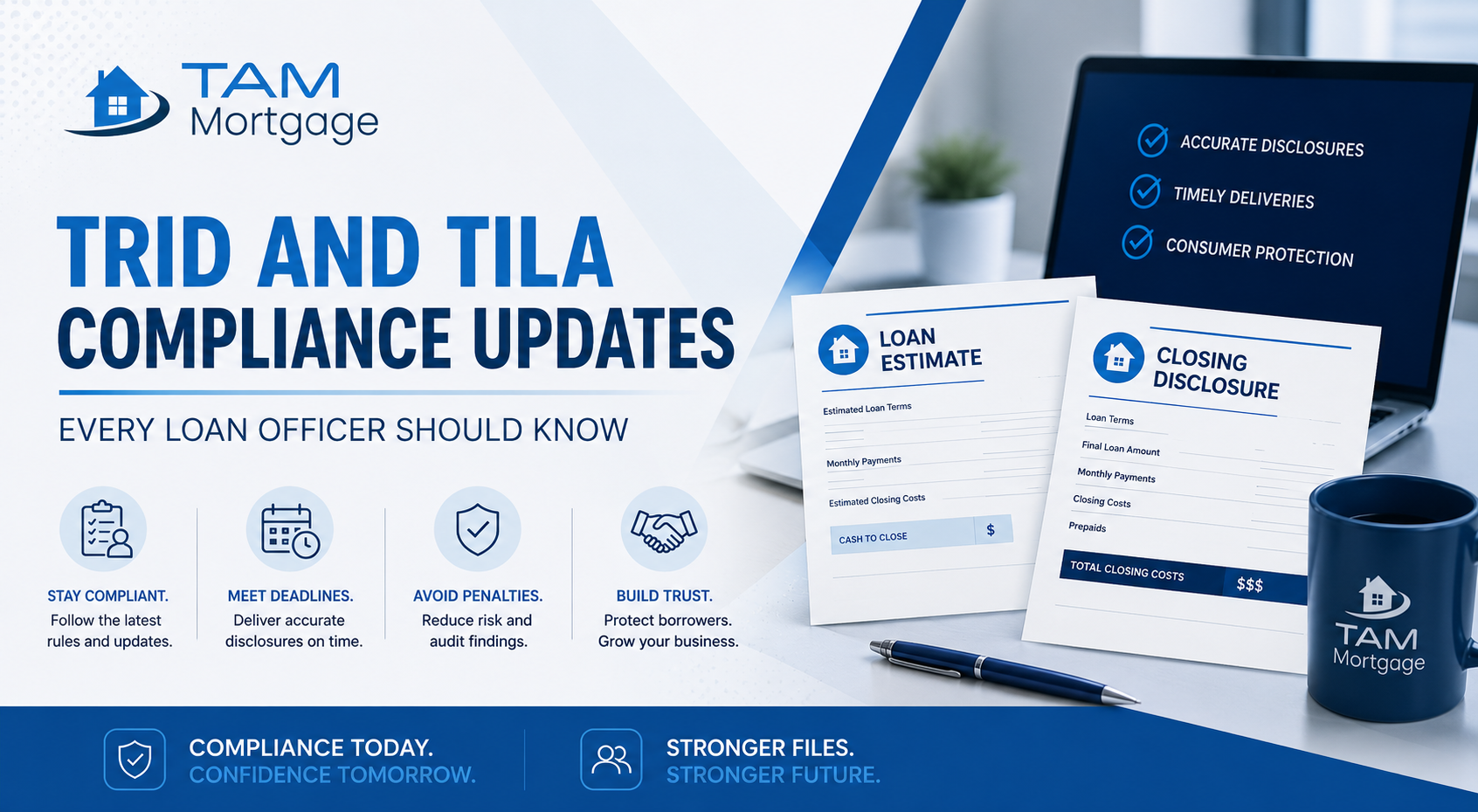
Regulatory compliance isn’t optional in mortgage lending—it’s your foundation. As a loan officer, staying current with TRID and TILA requirements protects your borrowers, your lender, and your reputation. With regulatory agencies tightening oversight and enforcement actions increasing, understanding the latest changes to these critical disclosure rules has never been more important.
What Is TRID and TILA—And Why It Matters
TILA (Truth in Lending Act) and TRID (TILA Rule Integrated Disclosures) form the backbone of consumer protection in mortgage lending. TILA requires lenders to disclose all costs, terms, and conditions of a loan clearly and prominently. TRID, implemented in 2015, integrated these disclosures into two critical documents: the Loan Estimate and the Closing Disclosure.
For loan officers, this means accuracy is non-negotiable. A single error—a missed disclosure deadline, an incomplete form, or inconsistent information—can trigger regulatory fines, legal liability, and audit flags. Understanding these rules isn’t just compliance; it’s protecting your business.
Key TRID Documentation Standards Every LO Must Master
The foundation of TRID compliance rests on two documents: proper execution and timing.
The Loan Estimate must be provided within three business days of the borrower’s application. This document outlines estimated loan terms, monthly payments, closing costs, and cash-to-close amounts. Any changes after this point require careful documentation and, in some cases, a revised Loan Estimate.
The Closing Disclosure must be provided at least three business days before closing. This is your final truth document—it’s where all loan terms, final costs, and prepaid expenses appear. Borrowers must review and sign it, and any discrepancies between the Loan Estimate and Closing Disclosure must be justified and explained.
The key compliance requirement: these documents must be consistent, complete, and delivered on time. No exceptions.
Recent Regulatory Updates: What’s Changed
Regulatory agencies continue to scrutinize TRID compliance. Recent CFPB guidance emphasizes:
- Accuracy in cost estimates. Lenders must avoid low-balling estimates to secure loans. Estimated costs must reflect actual, reasonable charges.
- Clearer disclosure formatting. The CFPB has clarified requirements around tables, spacing, and readability to ensure borrowers genuinely understand the information.
- Service provider accountability. If a third party (title company, appraiser, inspector) provides costs, you’re responsible for ensuring those costs are accurately reflected on disclosures.
- Fair lending compliance. TRID disclosures must not show discriminatory patterns. Regular audits of your disclosures by loan amount, loan purpose, and applicant characteristics help identify issues.
Common TRID and TILA Compliance Mistakes—And How to Avoid Them
1. Missing or Late Disclosure Deadlines
Deadline violations are among the most common violations. Implement a tracking system or CRM checklist to ensure Loan Estimates are delivered within three business days and Closing Disclosures at least three days before closing.
2. Inconsistent Information Between Documents
Numbers that don’t match across documents—loan amount, rate, payment, fees—trigger red flags. Use integrated loan origination systems to auto-populate data and reduce manual entry errors.
3. Vague or Missing Explanation of Changes
If the Closing Disclosure differs from the Loan Estimate, document why. “Changed market conditions” is not sufficient. “Actual appraisal value came in $10,000 lower than estimate, reducing loan amount from $400,000 to $390,000” is clear and defensible.
4. Incomplete or Inaccurate Prepaid Items
Property taxes, homeowners insurance, and HOA fees must be calculated accurately. Working with your title company and insurance partners ensures these figures are correct before closing.
5. Failing to Provide Borrower Acknowledgments
Borrowers must sign and receive the Closing Disclosure. Maintain clear records of delivery and acknowledgment—this is your proof of compliance.
Documentation Standards: Your Audit-Ready Checklist
To stand up to regulatory scrutiny, your loan files should include:
- Signed and dated Loan Estimate with delivery confirmation
- All revised Loan Estimates (if applicable) with clear reasoning
- Signed Closing Disclosure with delivery confirmation (at least three days pre-closing)
- Written explanations for any estimate-to-closing variance
- Correspondence documenting borrower communications about costs or terms
- Service provider cost documentation (appraisal, title, inspection, insurance quotes)
- Evidence of fair lending compliance (no pattern of disparate treatment)
Best Practices for TRID and TILA Compliance
Automate where possible. Use loan origination software that integrates TRID requirements into your workflow. This reduces manual errors and ensures consistent formatting.
Train your team regularly. Regulatory requirements evolve. Annual compliance training for all staff handling disclosures keeps everyone accountable.
Conduct internal audits. Quarterly reviews of random loan files help catch errors before regulators do. Look for timing issues, inconsistencies, and documentation gaps.
Communicate proactively with borrowers. Explain why costs are what they are. Clear communication prevents surprises at closing and reduces dispute risk.
Stay informed. Follow CFPB updates, consumer alerts, and enforcement actions. These reveal emerging compliance priorities.
Conclusion: Compliance as Competitive Advantage
TRID and TILA compliance isn’t a burden—it’s a competitive advantage. Loan officers who master these rules close faster, face fewer audit flags, and build trust with borrowers. Your lender will notice, and your reputation will reflect it.
The regulatory landscape continues to evolve, so commit to staying current. A small investment in compliance training and documentation discipline today prevents costly penalties and legal exposure tomorrow.
Ready to strengthen your TRID and TILA knowledge? Connect with compliance experts or attend industry training to ensure your loan files meet the highest standards.