
Broker vs. Retail vs. Correspondent Lending: Which Model Pays Loan Officers More?
KEy TakeAways
- The three main mortgage business models for loan officers are broker, retail, and correspondent lending, and each pays commission differently.
- Broker LOs typically earn the widest compensation range because they can shop multiple wholesale lenders for pricing, but they carry more overhead and less brand support.
- Retail LOs usually get the most structured support (leads, marketing, processing) in exchange for a lower commission split and less pricing control.
- Correspondent LOs often land in the middle: they underwrite and fund in-house like a retail shop but price loans more competitively, closer to broker economics.
- Take-home pay depends less on the label and more on split percentage, volume, product mix, and the tools and leads a shop actually provides.
- A hybrid correspondent structure, like TAM Mortgage’s, is built to combine in-house pricing control with the support of a full lending platform.
What Is the Difference Between Broker, Retail, and Correspondent Lending?
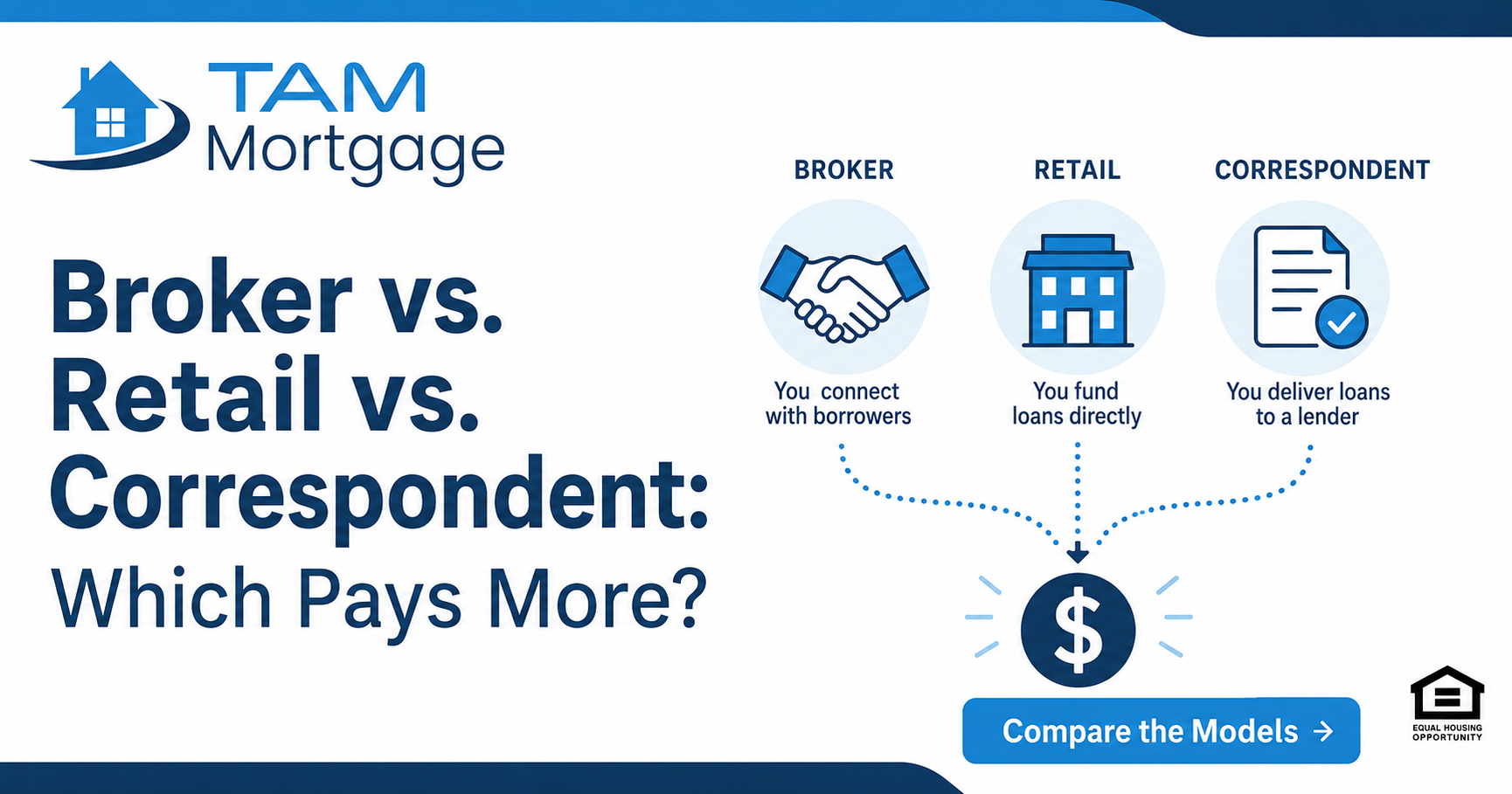
A broker originates a loan and shops it to outside wholesale lenders. A retail lender originates, underwrites, and funds the loan itself under one roof. A correspondent lender underwrites and funds in-house but sells the loan to investors shortly after closing. Each structure changes who controls pricing, who owns the borrower relationship, and how the loan officer gets paid.
Brokers work with a menu of wholesale investors, which can mean sharper pricing but also multiple underwriting overlays and turn times to manage. Retail lenders control the process end to end, typically with heavier marketing and lead support but less flexibility to move pricing deal-by-deal. Correspondent lenders sit in between: they fund with their own warehouse line, giving loan officers more pricing authority than a typical retail shop while still delivering in-house underwriting speed.
How Does Loan Officer Compensation Differ Across the Three Models?
| Model | Typical Pay Structure | Pricing Control | Overhead for the LO |
|---|---|---|---|
| Broker | Commission split, often tiered by volume | High — can compare multiple wholesale lenders | Higher — LO often covers more of their own marketing/tools |
| Retail | Salary plus commission, or commission-only with company-set pricing | Low to moderate — pricing set by the lender | Lower — company usually provides leads, marketing, and processing |
| Correspondent | Commission split with in-house pricing authority | Moderate to high — LO can often negotiate within investor guidelines | Moderate — shared support with more pricing flexibility than retail |
Exact splits vary widely by company, region, and production history, and no lender can guarantee a specific commission figure. What matters is understanding which levers — split percentage, volume bonuses, lead cost, and technology fees — actually drive net pay in each model.
Which Model Offers Loan Officers the Highest Take-Home Pay?
There is no universal answer, because take-home pay is a function of split, volume, and expenses, not the business model’s label alone. A high-volume broker with strong lender relationships can out-earn a retail LO, but absorbs more marketing costs and compliance burden. A correspondent structure often appeals to experienced LOs who want more pricing say than retail without the full overhead of an independent brokerage.
The honest way to compare offers is to model net commission after splits, lead costs, and technology fees, using an LO’s actual recent closed-loan mix rather than headline split percentages alone.
What Other Factors Should Loan Officers Weigh Beyond Commission Splits?
Compensation is only part of the decision. Loan officers should also weigh:
- Product breadth — access to conventional, FHA, VA, USDA, jumbo, and non-QM programs so fewer borrowers get turned away.
- Turn times and underwriting support — faster, predictable closings protect an LO’s reputation with referral partners.
- Marketing and lead generation — whether the company supplies leads and CRM tools, or the LO self-generates.
- Licensing and compliance support — help with state licensing and RESPA training reduces personal liability.
- Growth path — whether the model supports building a team or expanding into new markets.
How Does TAM Mortgage’s Structure Compare?
TAM Mortgage, LLC operates a correspondent-style lending model designed to give loan officers in-house pricing flexibility across a broad menu of loan programs, including conventional, FHA, VA, jumbo, and non-QM options, without the full overhead of running an independent shop. Loan officers evaluating a move should ask any prospective partner network for a transparent split structure, real turn-time data, and a clear view of what marketing and technology support is actually included — not just an advertised commission range.
Frequently Asked Questions
Is it better to be a mortgage broker or a retail loan officer?
It depends on whether an LO values pricing flexibility and independence (broker) more than structured support, leads, and brand recognition (retail). Both can be financially successful with the right volume and split.
Do correspondent lenders pay loan officers more than retail lenders?
Correspondent lenders often give LOs more pricing control than retail, which can translate into stronger commission outcomes on certain loans, but actual pay still depends on the specific split, product mix, and support provided.
What is a typical commission split for a mortgage loan officer?
Splits vary significantly by company, experience level, and production volume, so LOs should request a detailed, written split schedule rather than relying on advertised averages.
Can a loan officer switch between broker, retail, and correspondent models during their career?
Yes. Many experienced LOs move between models as their production, licensing, and business goals change, often carrying their book of referral relationships with them.
What should a loan officer ask before joining a new mortgage company?
Ask for the exact split schedule at current volume, average turn times, available loan programs, marketing/lead support, and how licensing and compliance training are handled.
If you’re comparing broker, retail, and correspondent opportunities, contact TAM Mortgage’s team for a transparent look at our split structure and platform, or explore our products and services and learning center to see the full picture before you make a move.
This article is for general informational purposes and is not a guarantee of specific commission, compensation, or employment terms. TAM Mortgage, LLC — NMLS ID #2715690. Equal Housing Opportunity.