
30-Year Fixed Loan
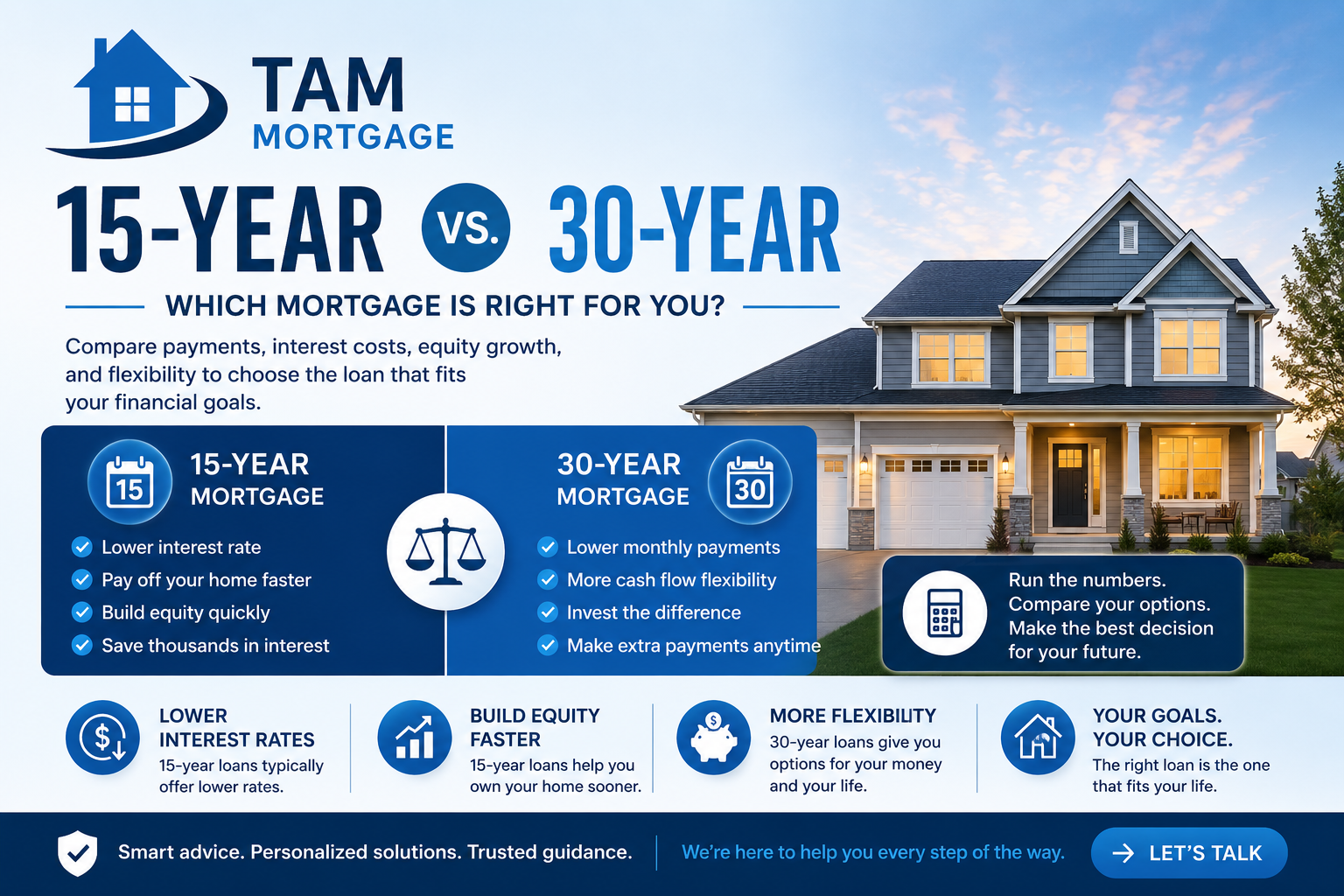
One of the first big decisions you’ll face when buying a home — or refinancing one — is choosing your mortgage term. And in most cases, that conversation comes down to two options: a 15-year mortgage or a 30-year mortgage.
I’ve worked with hundreds of Texas homebuyers over the years, and I can tell you that this question doesn’t have a universal answer. The right choice depends entirely on your financial situation, your goals, and honestly, how you sleep at night. What I can do is break down both options clearly so you can walk into that conversation with your lender already knowing what matters to you.
What a 15-Year Mortgage Actually Means for Your Wallet
A 15-year fixed mortgage does exactly what it sounds like — you pay off your home in half the time of a traditional loan. And lenders reward you for it.
Because the repayment window is shorter, lenders take on less risk. That’s why 15-year mortgages typically carry lower interest rates than 30-year loans — often anywhere from 0.5% to 0.75% lower, sometimes more depending on market conditions.
Let’s put some real numbers to this. Say you’re borrowing $320,000 (a $400,000 home with 20% down):
- 15-year at 6.0%: Monthly payment around $2,702 | Total interest paid: roughly $166,000
- 30-year at 6.75%: Monthly payment around $2,076 | Total interest paid: roughly $427,000
That’s a difference of over $260,000 in interest over the life of the loan. That’s not a rounding error — that’s a second home, a retirement account, or your kids’ college tuition. The 15-year borrower also builds equity significantly faster, which matters if you ever want to tap into your home’s value or sell during a market dip.
Who thrives with a 15-year mortgage?
- High-income earners with stable, predictable paychecks
- Homeowners who want to retire mortgage-free
- Buyers in their 40s or 50s who don’t want to carry debt into retirement
- Anyone whose primary goal is minimizing total interest cost
The honest downside? The higher monthly payment — in our example, about $626 more per month — leaves less room to breathe. If your income fluctuates, you’re self-employed, or you have other major financial goals like building an investment portfolio, that tighter cash flow can become a real constraint.
Why the 30-Year Mortgage Is Still the Right Call for Many Buyers
The 30-year fixed mortgage has been the backbone of American homeownership for decades, and there’s a reason for that. It makes buying a home accessible to more people by spreading the payments out over time.
Yes, you pay more interest in the long run. But that lower monthly payment isn’t just about comfort — it creates financial flexibility that has real strategic value.
Think about it this way: if your monthly mortgage payment is $626 lower, that’s $626 you could put toward:
- A fully funded emergency reserve
- Maxing out your 401(k) or IRA
- Your children’s education fund
- A rental property investment
Done right, that freed-up cash can absolutely outperform the interest savings of a shorter loan — especially if you’re investing in tax-advantaged accounts or assets with strong long-term returns. This is a legitimate financial strategy, not just a rationalization for borrowing more.
Who makes the most of a 30-year mortgage?
- First-time homebuyers managing tight budgets
- Self-employed borrowers with variable monthly income
- Families planning to invest the difference rather than lock it into home equity
- Buyers who value the ability to make extra payments on their own terms
That last point is important. A 30-year mortgage doesn’t mean you’re locked into 30 years. You can make extra principal payments whenever you want, effectively shortening your loan without being required to commit to the higher payment every month. That flexibility can be a lifeline during an unexpected job change, a medical event, or any other financial disruption.
The Comparison at a Glance
Factor | 15-Year Mortgage | 30-Year Mortgage |
Monthly Payment | Higher | Lower |
Interest Rate | Lower | Higher |
Total Interest Paid | Significantly Less | Significantly More |
Equity Build-Up | Fast | Slower |
Cash Flow Flexibility | Lower | Higher |
Best For | High earners, debt-averse buyers | First-timers, investors, variable-income borrowers |
Can You Get the Best of Both Worlds?
Absolutely — and this is where smart planning comes in.
If you take out a 30-year mortgage but make consistent extra principal payments, you can pay off the loan years early while still retaining the flexibility to pull back during tight months. Even an extra $200–$300 per month applied to principal can shave years off your loan and save tens of thousands in interest.
You can also refinance from a 30-year into a 15-year mortgage later on, once your income grows and you’re in a stronger financial position. Many homeowners start with a 30-year loan in their early years and refinance into a 15-year once their career stabilizes. Just keep closing costs in mind when you run those numbers.
Questions to Ask Before You Decide
Before settling on a term, run through these:
- What’s my realistic monthly budget — not the maximum I can qualify for, but the payment I’d be comfortable making even in a tough month?
- Is my income stable, or does it fluctuate enough that I need that flexibility buffer?
- What are my other financial priorities? If I’m not maxing out retirement accounts yet, the 30-year’s lower payment might be the smarter path.
- How long do I plan to stay in this home? If you’re likely to sell in 7–10 years, the long-term interest savings of a 15-year matter less than you think.
- What does becoming debt-free mean to me? For some people, owning their home outright is more than financial — it’s peace of mind. That’s a valid reason to choose the 15-year, even if the math doesn’t perfectly favor it.
Let TAM Mortgage Help You Run the Numbers
There’s no single right answer here. The best mortgage term is the one that fits your life — your income, your goals, and your timeline. What I always tell buyers is this: don’t choose a mortgage term based on what sounds impressive. Choose it based on what you can sustain, and what gives you room to build the financial life you actually want.
At TAM Mortgage, we work with Texas homebuyers every day to find the loan structure that truly fits — not just the one that looks good on paper. Whether you’re buying your first home, upgrading, or exploring a refinance, our team is here to walk through the real numbers with you.
Ready to figure out which mortgage term makes sense for your situation? Contact TAM Mortgage today at www.tammortgage.com — and let’s build a plan that works for your future.
TAM Mortgage is a Texas-based mortgage lender offering competitive home loan and refinance solutions for buyers across the state. Our team specializes in helping first-time buyers and experienced homeowners find the right mortgage — with clear guidance every step of the way.