
Government Loans vs Private Loans: Which Home Financing Option Is Better?
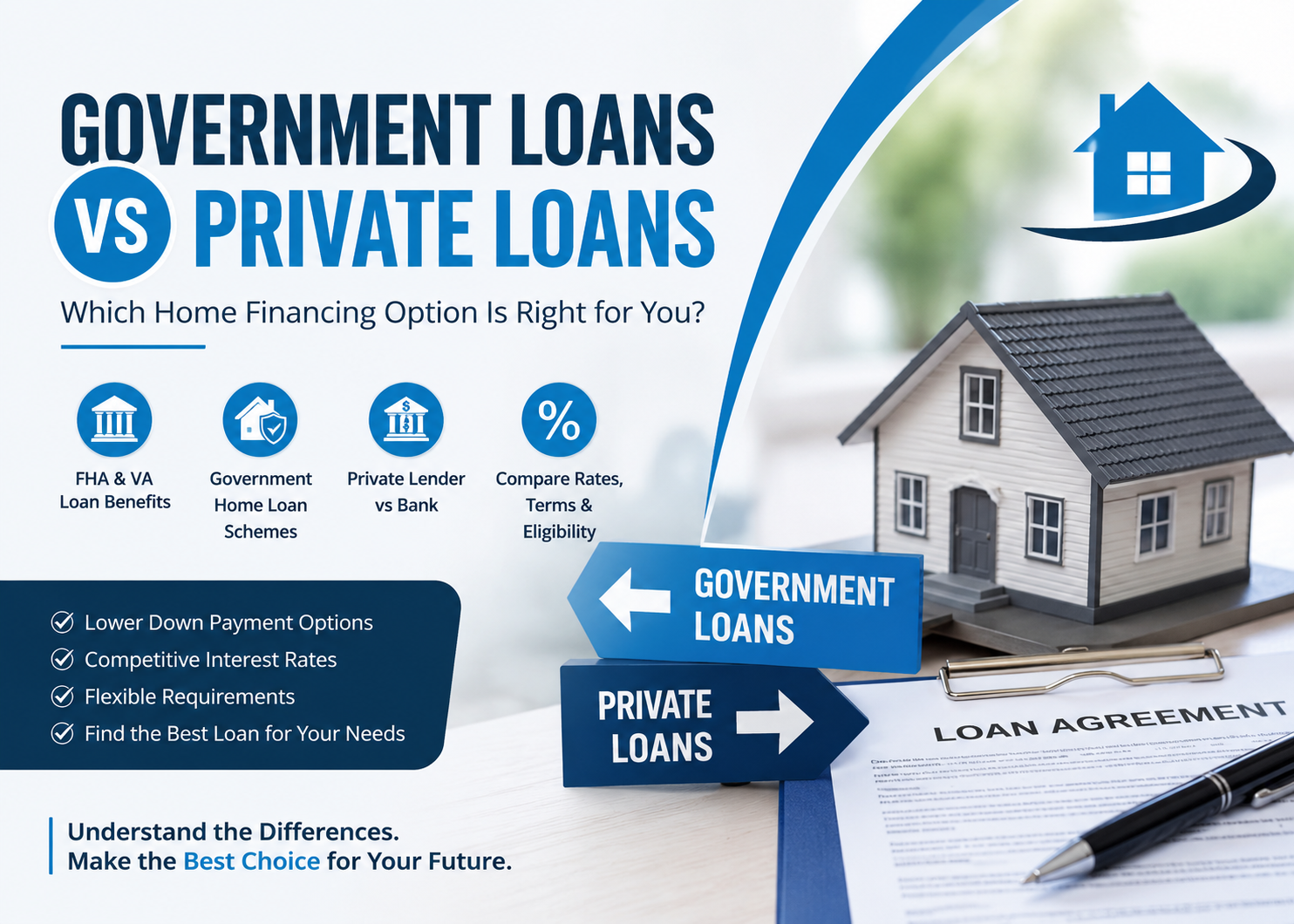
Buying a home is one of the biggest financial decisions you will ever make — and choosing the right loan is just as important as choosing the right property. With dozens of mortgage options available today, the choice between government-backed loans and private loans can feel overwhelming.
Whether you are a first-time buyer, a veteran, or someone with an established credit history, understanding the core difference between government vs private loans will help you secure the best deal for your financial situation. In this guide, we break down both loan types so you can make a confident, informed decision.
What Are Government Loans?
Government loans are mortgage products that are insured or guaranteed by a federal agency. Because the government backs these loans, lenders take on less risk — which means they can offer more flexible qualification requirements to borrowers who might not qualify for conventional financing.
Common Types of Government Home Loan Schemes
FHA Loans (Federal Housing Administration): Designed for low-to-moderate income buyers, these loans require as little as 3.5% down and accept lower credit scores.
VA Loans (Department of Veterans Affairs): Exclusively for veterans, active military, and eligible surviving spouses, offering zero down payment and no private mortgage insurance (PMI).
USDA Loans (U.S. Department of Agriculture): Targeted at rural and suburban homebuyers who meet income requirements, often with zero down payment options.
To explore which government home loan schemes you may qualify for, visit TAM Mortgage – Government Loan Options.
Who Qualifies for Government Loans?
- First-time homebuyers with limited savings
- Veterans and active-duty military personnel
- Low-to-moderate income borrowers
- Rural homebuyers in USDA-eligible areas
What Are Private Loans?
Private loans — also called conventional loans — are mortgage products offered by banks, credit unions, and private lenders without government backing. Because these lenders assume full risk, they typically require stronger creditworthiness from borrowers.
Types of Private Loans
- Conventional Loans: The most common mortgage type, ideal for borrowers with good credit and stable income.
- Jumbo Loans: For high-value properties that exceed conforming loan limits set by Fannie Mae and Freddie Mac.
- Adjustable-Rate Mortgages (ARMs): Loans with interest rates that change periodically, often starting lower than fixed-rate options.
Who Usually Chooses Private Loans?
- Borrowers with credit scores of 700 or higher
- High-income buyers purchasing luxury or investment properties
- Those who want to avoid mortgage insurance by putting 20% or more down
Government vs Private Loans: Key Differences
Down Payment Requirements
Government loans are well known for their low down payment requirements. FHA loans start at just 3.5%, while VA and USDA loans can be obtained with zero down. Private (conventional) loans typically require 5–20% down, though some programs allow 3% for qualifying first-time buyers.
Credit Score Eligibility
FHA loans are accessible to borrowers with credit scores as low as 580. Some lenders even approve scores of 500 with a higher down payment. Private lenders generally prefer scores of 620 and above, with the best rates reserved for borrowers at 740+. Learn more about mortgage approval and credit requirements at TAM Mortgage.
Interest Rates Comparison
Government-backed loans often carry competitive rates because of the reduced lender risk. VA loans especially are known for below-market interest rates. Private loans use risk-based pricing — the better your credit score and financial profile, the lower your rate. However, for borrowers with excellent credit, private lenders can sometimes offer rates that match or beat government programs.
Mortgage Insurance Costs
FHA loans require both an upfront mortgage insurance premium (UFMIP) of 1.75% of the loan amount and an ongoing annual MIP. Conventional loans require PMI only if you put down less than 20% — and PMI can be removed once you build sufficient equity, unlike FHA’s MIP which often lasts the life of the loan.
Loan Approval Process
Government loans involve stricter property appraisal requirements and can take slightly longer to process due to the additional documentation required by federal agencies. Private loans generally have a more streamlined process, especially with well-qualified borrowers.
Flexibility for Self-Employed Borrowers
Self-employed buyers often find private lenders more accommodating. Non-QM (non-qualified mortgage) products offered by private lenders may use bank statements or alternative income documentation. Government loans typically rely on traditional income verification. Explore options for self-employed homebuyers at TAM Mortgage.
FHA and VA Loan Benefits Explained
FHA Loan Benefits
- Accepts credit scores as low as 580 (or 500 with 10% down)
- Down payments as low as 3.5%
- More lenient debt-to-income ratio requirements
- Available to non-veterans and first-time buyers
Read our full breakdown of FHA Loan Requirements at TAM Mortgage.
VA Loan Benefits
- Zero down payment required
- No private mortgage insurance (PMI)
- Competitive, often below-market interest rates
- Flexible credit requirements
- Available to veterans, active duty, and eligible surviving spouses
Check if you qualify with our VA Loan Eligibility Guide at TAM Mortgage.
When FHA or VA Loans Make Sense
If you are a first-time buyer with limited savings or a less-than-perfect credit history, an FHA loan is likely your best path forward. If you are a veteran or active military member, the VA loan is almost always the superior choice — the zero-down, no-PMI structure makes it one of the most valuable benefits available to servicemembers.
Private Lender vs Bank: What’s the Difference?
Traditional Banks
Traditional banks and credit unions follow standard underwriting guidelines, often set by Fannie Mae and Freddie Mac (for conventional loans). The process is highly regulated, offering stability and consumer protections — but can be rigid for borrowers with complex financial profiles.
Private Lenders
Private lenders operate with more flexibility. They can offer non-QM loans, faster approvals, and creative loan structures. However, this flexibility often comes at a cost — private loans may carry higher interest rates or fees compared to bank products.
Which Option Is Better for Fast Approval?
For speed, private lenders often win. Many can pre-approve borrowers within 24–48 hours and close loans faster than traditional banks. If you need a fast pre-approval, start your application at TAM Mortgage today.
Pros and Cons of Government Loans
Pros
- Lower down payment requirements (as low as 0–3.5%)
- More accessible credit score requirements
- Easier qualification for first-time and low-income buyers
- Competitive interest rates backed by federal programs
Cons
- Mandatory mortgage insurance that can add significant cost over the loan term
- Property condition and appraisal restrictions
- Loan limits that may exclude high-cost markets
Pros and Cons of Private Loans
Pros
- Higher loan limits — ideal for luxury and investment properties
- PMI can be removed once equity reaches 20%
- More property types and conditions are eligible
- Faster closing timelines in many cases
Cons
- Stricter credit and income requirements
- Higher down payment expectations (typically 5–20%)
- Higher rates for borrowers with less-than-ideal credit
Which Loan Type Is Right for You?
Best for First-Time Homebuyers
FHA loans are the go-to choice. Low down payment, flexible credit, and accessible qualification make them ideal. Explore the First-Time Homebuyer Guide at TAM Mortgage.
Best for Veterans
VA loans, without question. The combination of zero down, no PMI, and competitive rates makes this one of the most powerful mortgage products available.
Best for High Credit Score Borrowers
Conventional private loans. Borrowers with 740+ credit scores can access the best rates and terms, and they can avoid mortgage insurance entirely with a 20% down payment.
Best for Self-Employed Buyers
Non-QM private lender products are often the best fit, using bank statements or asset-based qualification rather than traditional W-2 income documentation.
Best for Investment Properties
Private loans and conventional loans. Government-backed loans (FHA, VA, USDA) are generally limited to primary residences and cannot be used for investment or vacation properties.
Common Mistakes to Avoid When Choosing a Mortgage
- Focusing only on interest rates while ignoring closing costs and insurance fees
- Choosing a long-term adjustable-rate mortgage without fully understanding rate-change risks
- Not shopping multiple lenders — even a 0.25% rate difference can mean thousands over the life of a loan
- Skipping mortgage pre-approval before house hunting, which can weaken your offer
Tips to Improve Your Loan Approval Chances
- Improve your credit score by paying down debt and avoiding new credit inquiries before applying
- Reduce your debt-to-income (DTI) ratio — most lenders prefer below 43%
- Save enough for a meaningful down payment to unlock better rate tiers
Compare multiple lenders before deciding. Our team at TAM Mortgage can help you review your full range of options — including fixed vs adjustable mortgage rates.
Final Thoughts
The choice between government and private loans ultimately comes down to your personal financial situation, credit profile, and homeownership goals. Government-backed loans offer the best entry point for first-time buyers, veterans, and those with limited savings. Private loans reward borrowers who have stronger credit and larger down payments with greater flexibility and fewer long-term insurance costs.
Before making any decision, consult with a qualified mortgage advisor who can evaluate your complete financial picture. Contact the TAM Mortgage team today for personalized guidance and fast pre-approval options.
Frequently Asked Questions (FAQ)
Are government loans easier to get than private loans?
Generally, yes. Government loans like FHA are designed with more flexible credit and income requirements to serve borrowers who may not qualify for conventional financing. However, they do come with additional costs such as mandatory mortgage insurance.
What credit score is needed for FHA loans?
FHA loans typically require a minimum credit score of 580 for the standard 3.5% down payment. Borrowers with scores between 500–579 may still qualify, but will need to put at least 10% down.
Do VA loans require mortgage insurance?
No. One of the biggest VA loan benefits is that there is no PMI requirement, regardless of your down payment amount. This can save eligible veterans hundreds of dollars per month compared to FHA or conventional options with less than 20% down.
Can private lenders approve loans faster than banks?
Yes, in many cases. Private lenders often have more streamlined underwriting processes and can offer pre-approvals within 24–48 hours, with faster overall closing timelines than traditional banks, especially for well-qualified borrowers.
Which loan is better for first-time homebuyers?
FHA loans are typically the best option for first-time homebuyers due to the low 3.5% down payment requirement, flexible credit standards, and accessible qualification process. Veterans should always explore the VA loan first, as it offers even greater benefits.
What are the biggest advantages of government home loan schemes?
The key advantages include lower entry barriers (low or no down payment), more accessible credit requirements, and government-backed security that makes lenders more willing to work with a wider range of borrowers. Programs like VA loans also offer the unique benefit of no mortgage insurance.
Ready to Find Your Perfect Mortgage?
Need help choosing between government and private loans? Our mortgage experts at TAM Mortgage are ready to guide you every step of the way — from comparing loan types to fast pre-approval. Get started today →