
How Does a Home Loan Work? Steps, Guide, FAQs and More
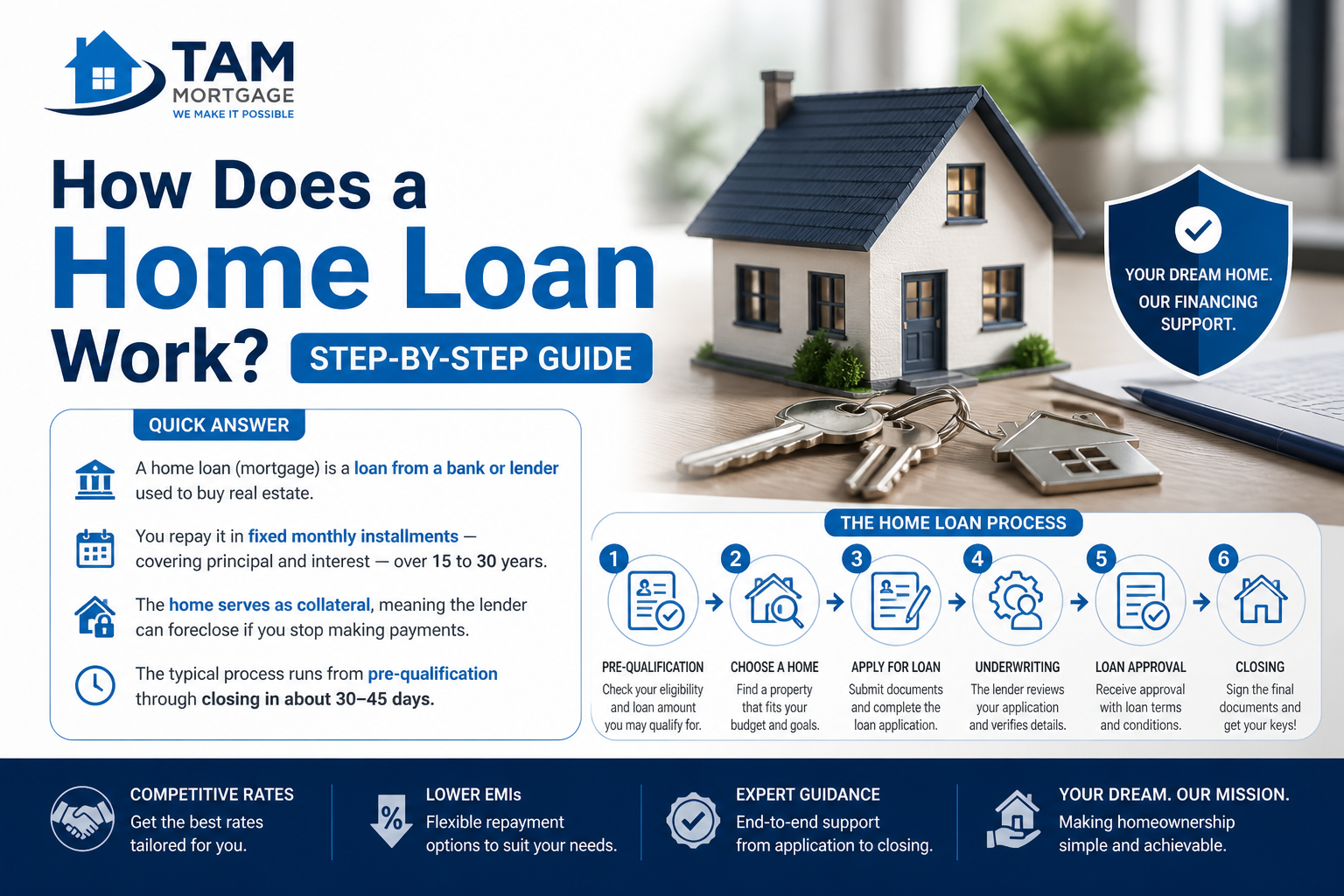
How Does a Home Loan Work? (Step-by-Step Guide)
Quick Answer: A home loan (mortgage) is a loan from a bank or lender used to buy real estate. You repay it in fixed monthly installments — covering principal and interest — over 15 to 30 years. The home serves as collateral, meaning the lender can foreclose if you stop making payments. The typical process runs from pre-qualification through closing in about 30–45 days.
What Is a Home Loan?
A home loan — commonly called a mortgage — is a secured loan specifically designed to purchase real estate. The property you buy serves as collateral for the loan. You agree to repay the lender (a bank, credit union, or mortgage company) over a set period, typically 15 or 30 years, in regular monthly payments.
Your monthly payment is usually made up of four components, often referred to as PITI:
- Principal — The portion that reduces your loan balance
- Interest — The lender’s fee for lending you the money
- Taxes — Your share of annual property taxes, held in escrow
- Insurance — Homeowners insurance (and PMI, if applicable), also held in escrow
Understanding these four elements is the foundation of understanding how a mortgage works.
Step-by-Step: How a Home Loan Works
Step 1: Check Your Financial Health
Before you apply, lenders evaluate three key factors:
Credit Score Your credit score is the single biggest factor in determining whether you’re approved and what interest rate you’ll receive. General minimums:
Loan Type | Minimum Credit Score |
Conventional | 620 |
FHA | 580 (3.5% down) / 500 (10% down) |
VA (veterans) | No official minimum |
USDA | 640 |
The best interest rates go to borrowers with scores of 740 or higher.
Debt-to-Income Ratio (DTI) Your DTI compares your monthly debt payments to your gross monthly income. Most lenders prefer a DTI of 43% or lower. A lower DTI signals to lenders that you can comfortably handle a new monthly mortgage payment.
Down Payment This is the upfront cash you pay toward the home’s purchase price. The remainder is what you borrow.
Loan Type | Minimum Down Payment |
Conventional | 3–5% |
FHA | 3.5% |
VA | 0% |
USDA | 0% |
Pro Tip: If your down payment is less than 20% on a conventional loan, you’ll be required to pay Private Mortgage Insurance (PMI) — typically 0.5–1.5% of the loan per year — until your equity reaches 20%.
Step 2: Get Pre-Qualified or Pre-Approved
Pre-qualification is a quick, informal estimate of how much you might be able to borrow. You provide basic financial details (income, assets, debts), and the lender gives you a ballpark figure. No hard credit inquiry is required at this stage.
Pre-approval is more formal and carries far more weight. The lender verifies your financial documents, runs a hard credit check, and issues a pre-approval letter stating how much they’ll lend you. In competitive housing markets, sellers often won’t consider offers without a pre-approval letter.
Documents typically required for pre-approval:
- W-2s and tax returns (last 2 years)
- Recent pay stubs (last 30 days)
- Bank and investment account statements
- Government-issued ID
- Employment verification
Step 3: Choose the Right Type of Home Loan
Not all mortgages are the same. Choosing the right loan type can save you thousands of dollars.
Conventional Loans Not backed by the government. Typically require higher credit scores (620+) and a minimum 3% down payment. Ideal for borrowers with solid credit and stable income.
FHA Loans Insured by the Federal Housing Administration. Require lower credit scores and as little as 3.5% down — making them popular with first-time buyers. The tradeoff: you pay a mortgage insurance premium (MIP) for the life of the loan in most cases.
VA Loans Backed by the Department of Veterans Affairs. Available to eligible veterans, active-duty service members, and surviving spouses. Offer 0% down, no PMI, and competitive rates.
USDA Loans Backed by the U.S. Department of Agriculture. Available to buyers in eligible rural and suburban areas with moderate-to-low income. Also offer 0% down.
Fixed-Rate vs. Adjustable-Rate Mortgages (ARMs)
- Fixed-rate: Your interest rate stays the same for the entire loan term (e.g., 30-year fixed). Predictable and stable.
- Adjustable-rate (ARM): Your rate is fixed for an initial period (e.g., 5 years), then adjusts periodically based on market conditions. Can be lower upfront, but carries risk if rates rise.
Step 4: Shop Lenders and Compare Rates
Never accept the first rate you’re offered. Even a 0.5% difference in interest rate on a $300,000 loan can amount to tens of thousands of dollars over 30 years. Get quotes from at least three lenders: banks, credit unions, and online mortgage lenders.
When comparing offers, look beyond the interest rate to the Annual Percentage Rate (APR), which includes the interest rate plus fees, giving you a true picture of the loan’s total cost.
Step 5: Submit Your Formal Mortgage Application
Once you’ve found a home and a lender, you formally apply. The lender collects all documentation and submits your file for processing. Within three business days of your application, the lender is legally required to provide a Loan Estimate — a standardized document that outlines:
- Estimated interest rate and monthly payment
- Projected closing costs
- Loan term and type
- Whether your rate can rise in the future
Review this document carefully and ask your lender to explain anything you don’t understand.
Step 6: Home Appraisal and Inspection
Home Appraisal Your lender orders an independent appraisal to confirm the home’s market value aligns with the purchase price. If the appraisal comes in lower than the purchase price, the lender won’t fund the gap — you’ll need to renegotiate the price, make up the difference in cash, or walk away.
Home Inspection While not required by lenders, a home inspection is strongly recommended. A licensed inspector examines the property for structural issues, plumbing or electrical problems, roof condition, and more. This can protect you from costly surprises after purchase and give you leverage to negotiate repairs with the seller.
Step 7: Underwriting
This is the lender’s deep-dive review of your entire application. An underwriter verifies:
- Your income, employment, and assets
- The accuracy of all documents
- The appraisal report
- Title search results (confirming no liens on the property)
During underwriting, do not open new credit accounts, take on new debt, make large deposits into your bank accounts without documentation, or change jobs. Any significant financial change at this stage can jeopardize your approval.
The underwriter may request additional documents — respond as quickly as possible to keep the process on track.
Step 8: Lock in Your Interest Rate
Interest rates change daily. A rate lock protects you from rate increases between the time of your application and the closing date. Rate locks typically last 30–60 days. If your closing is delayed beyond the lock period, you may need to pay a fee to extend it.
Current context (2025–2026): Mortgage rates have been stabilizing in the 6–7% range after the highs of 2023. Locking in sooner rather than later can provide peace of mind in a fluctuating market.
Step 9: Closing Disclosure and Final Review
At least three business days before your closing, you’ll receive a Closing Disclosure — a final, detailed breakdown of your loan terms, monthly payment, and all closing costs. Compare it line-by-line against your Loan Estimate to ensure nothing has changed unexpectedly.
Common closing costs include:
Cost | Typical Amount |
Origination/underwriting fee | 0.5–1% of loan amount |
Title insurance | 0.5–1% of purchase price |
Appraisal fee | $300–$500 |
Attorney fee (if required by state) | Varies |
Prepaid taxes and insurance | 1–3 months upfront |
Recording fees | $25–$250 |
Total closing costs typically run 2–5% of the loan amount. On a $300,000 home, that’s $6,000–$15,000 due at closing.
Step 10: Close on Your Home
Closing (also called settlement) is the final step. You’ll meet with your closing agent or attorney, sign a large stack of documents, and pay your down payment and closing costs via cashier’s check or wire transfer.
Once all documents are signed and funds are transferred, the deed is recorded in the public record and you receive the keys. You’re officially a homeowner.
The full process — from application to closing — takes an average of 41 days, according to ICE Mortgage Technology data.
How Is Your Monthly Mortgage Payment Calculated?
Your monthly payment is determined by four variables:
- Loan amount (purchase price minus down payment)
- Interest rate
- Loan term (15 or 30 years)
- Escrow (taxes and insurance)
Example: On a $300,000 loan at a 6.75% fixed rate over 30 years:
- Principal + Interest: ~$1,945/month
- Property taxes (estimated): ~$250/month
- Homeowners insurance: ~$100/month
- Total estimated payment: ~$2,295/month
In the early years of your mortgage, the majority of each payment goes toward interest. Over time, the balance shifts and more goes toward reducing your principal — this is called amortization.
Frequently Asked Questions
What credit score do I need to buy a house?
Most conventional lenders require a minimum score of 620. FHA loans accept scores as low as 580 (with 3.5% down) or 500 (with 10% down). VA loans have no set minimum. The higher your score, the better your interest rate.
How much down payment do I need?
As little as 3% on a conventional loan, 3.5% on an FHA loan, or 0% on VA and USDA loans. However, putting down less than 20% on a conventional loan means paying PMI.
How long does the mortgage process take?
On average, about 30–45 days from application to closing, though it can be shorter or longer depending on your lender and the complexity of your file.
What is PMI and can I avoid it?
Private Mortgage Insurance protects the lender if you default. It’s required on conventional loans when your down payment is less than 20%. You can avoid it by putting 20% down, or it cancels automatically once your equity reaches 20% of the home’s value.
What’s the difference between pre-qualification and pre-approval?
Pre-qualification is a rough estimate based on self-reported information. Pre-approval is a verified commitment based on actual documentation and a credit check — it carries significantly more weight with sellers.
Can I pay off my mortgage early?
Yes, most mortgages allow extra principal payments or early payoff. Check your loan terms for any prepayment penalty, though these are rare on modern U.S. mortgages.
Key Mortgage Terms to Know
Term | Definition |
Principal | The original loan amount you borrow |
Interest Rate | The annual cost of borrowing, expressed as a percentage |
APR | Annual Percentage Rate — includes interest plus fees |
Amortization | The schedule by which your loan balance is paid down over time |
Escrow | An account held by the lender to pay taxes and insurance |
PMI | Private Mortgage Insurance — required when down payment is under 20% |
DTI | Debt-to-Income ratio — your monthly debts divided by gross income |
LTV | Loan-to-Value ratio — loan amount divided by the home’s appraised value |
Rate Lock | A guarantee that your interest rate won’t change before closing |
Closing Disclosure | The final document detailing all loan terms and closing costs |
Bottom Line
A home loan works by allowing you to borrow the purchase price of a property (minus your down payment) from a lender, which you repay with interest in monthly installments over 15–30 years. The ten steps — from checking your finances and getting pre-approved, to choosing the right loan, completing underwriting, and closing — typically take about 30–45 days.
The keys to a smooth mortgage process are a strong credit score, a manageable debt-to-income ratio, organized financial documents, and choosing a lender whose terms fit your long-term goals. Comparing offers from multiple lenders before you commit can save you significantly over the life of your loan.