
Jumbo Loan vs Conventional Loan: What’s the Difference?
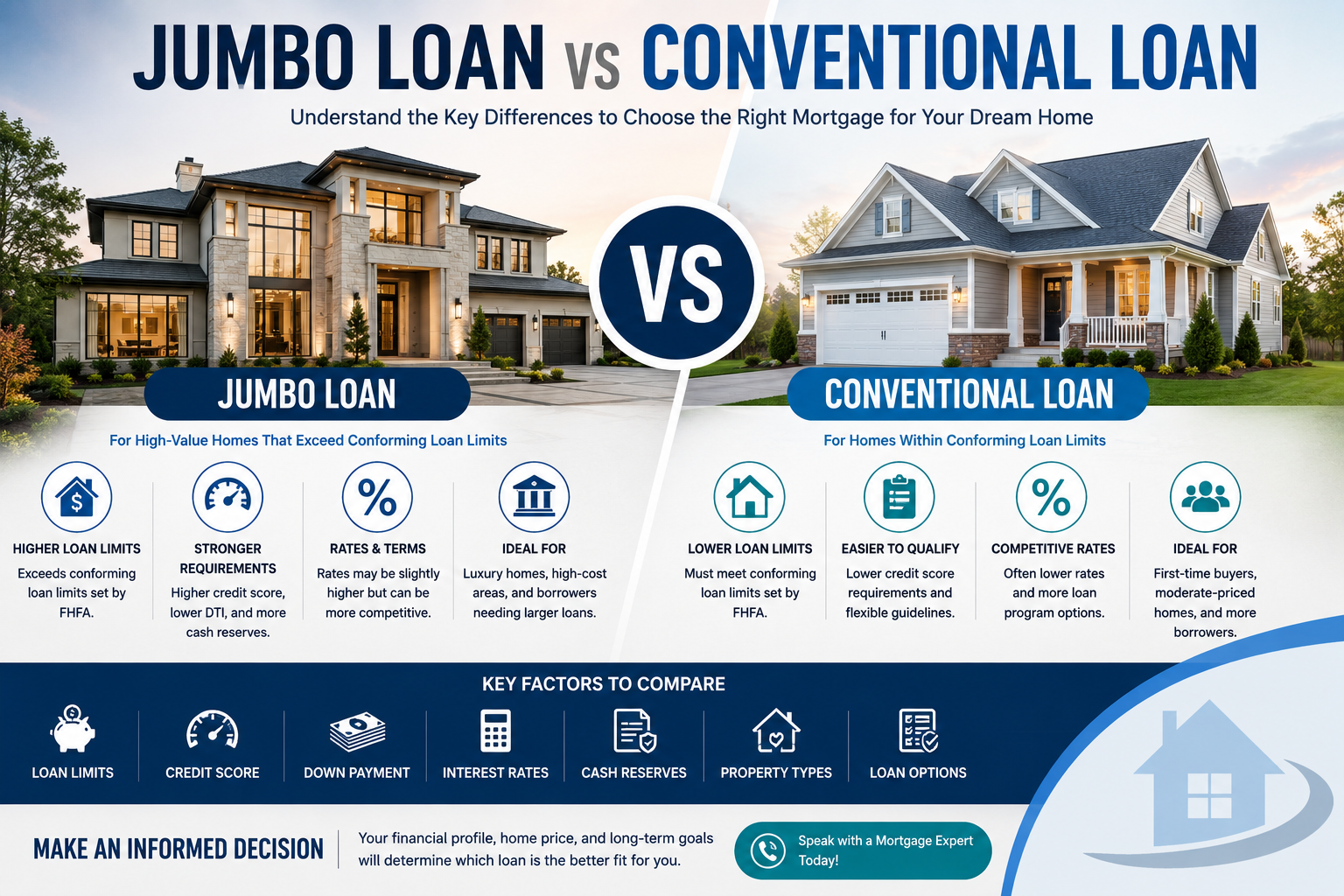
Buying a home is one of the biggest financial decisions you’ll ever make — and choosing the right mortgage type can save (or cost) you thousands of dollars over the life of your loan. If you’re purchasing a property priced above a certain threshold, you may find yourself at a crossroads: do you qualify for a conventional loan, or will you need jumbo financing?
Understanding jumbo loan limits, jumbo loan requirements, and how a jumbo vs conventional loan comparison plays out in the real world is essential before you sign anything. This guide walks you through every key difference so you can make a confident, informed decision.
What Is a Conventional Loan?
A conventional mortgage is any home loan that is not backed or insured by a federal government agency. These loans are offered by private lenders — banks, credit unions, and mortgage companies — and must adhere to guidelines set by Fannie Mae and Freddie Mac, the government-sponsored entities that purchase loans from lenders.
When a conventional loan stays within the borrowing limits set by the Federal Housing Finance Agency (FHFA), it’s called a conforming loan. This is significant because conforming loans can be sold on the secondary mortgage market, which keeps lender risk low and borrowing costs competitive.
Typical features of a conventional loan include:
- Loan amounts within FHFA conforming limits
- Down payments as low as 3% (for qualifying borrowers)
- Minimum credit score of around 620
- Debt-to-income (DTI) ratio generally below 45%
- Private mortgage insurance (PMI) required if down payment is under 20%
- Widely available from most mortgage lenders
Conventional loans are the most common mortgage type in the United States. They’re well-suited for first-time homebuyers, moderate-budget buyers, and anyone purchasing a property priced within standard market ranges.
👉 Learn more about your options at TAM Mortgage – Conventional Loan
What Is a Jumbo Loan?
A jumbo mortgage is a home loan that exceeds the conforming loan limits set by the FHFA. Because these loans surpass the threshold at which Fannie Mae and Freddie Mac can purchase them, they are considered non-conforming loans — meaning the lender holds them in-house or sells them through private channels.
This shifts more risk onto the lender, which is why jumbo loans typically carry stricter qualification standards. Jumbo financing is most commonly used for luxury home purchases, high-priced urban real estate, and investment properties in expensive markets.
Key characteristics of a jumbo loan include:
- Loan amounts exceeding conforming limits (typically $806,500+ in most U.S. counties in 2026)
- Higher minimum credit score requirements (usually 700–720+)
- Larger down payment expectations (often 10–20% or more)
- Stricter debt-to-income ratio requirements
- Cash reserve requirements after closing
- More extensive income documentation
- No PMI in most cases, but compensated by stricter underwriting
For buyers financing high value home loans on properties that fall outside standard market pricing, a jumbo mortgage may be the only viable path forward.
👉 Explore jumbo financing options at TAM Mortgage – Jumbo Loan
Why a $1 Difference Can Push You Into a Jumbo Loan
Here’s something that surprises many homebuyers: the line between a conventional and a jumbo loan is exact — and crossing it by even a single dollar changes everything about your financing.
If the conforming limit in your county is $806,500 and your loan amount is $806,501, you’re in jumbo territory. Suddenly you face tighter credit requirements, larger reserve expectations, and more documentation. This is why understanding the FHFA’s annual limit updates matters so much — especially in fast-appreciating markets.
Jumbo Loan vs Conventional Loan — Key Differences
Here’s a direct side-by-side comparison of the most important factors:
Feature | Conventional (Conforming) Loan | Jumbo Loan |
Loan Limit (2026) | Up to $806,500 (standard) | Above $806,500 |
Down Payment | As low as 3% | Typically 10–20%+ |
Credit Score | 620+ | 700–720+ |
Debt-to-Income Ratio | Up to ~45–50% | Generally ≤43% |
Interest Rate | Competitive market rates | Can be higher or comparable |
Cash Reserves | Not always required | 6–12+ months often required |
PMI Required | Yes, if <20% down | Rarely |
Property Types | Primary, secondary, investment | Luxury, high-value, investment |
Underwriting | Standard | Stricter, more documentation |
Secondary Market | Sold to Fannie/Freddie | Held by lender or private market |
This table makes clear why the conventional loan vs jumbo mortgage decision isn’t just about loan size — it’s about your full financial profile.
Understanding Jumbo Loan Limits in 2026
Jumbo loan limits are determined by what’s left over after the FHFA sets the annual conforming loan limits. For 2026, the baseline conforming loan limit is $806,500 for a single-family home in most U.S. counties. Any loan above this amount is classified as a jumbo loan.
However, the picture is more nuanced in high-cost areas. In counties where home prices are significantly above the national average — such as those in California, New York, Hawaii, and parts of the Pacific Northwest — the FHFA allows a higher conforming limit. In these areas, the ceiling can reach up to $1,209,750 for a single-family home in 2026.
What does this mean practically?
- A $900,000 loan in a standard-cost county = jumbo loan
- A $900,000 loan in a designated high-cost county = could still be conforming
The FHFA adjusts these limits annually based on national average home price data. As home values rise, so do the conforming thresholds — which means some buyers who needed jumbo loans in prior years may now qualify for conventional financing.
The Credit Score Gap Between Jumbo and Conventional Loans
Credit score requirements represent one of the starkest differences between these two loan types.
For a conventional loan, most lenders require a minimum credit score of 620, though borrowers with scores in the 740+ range typically receive the most favorable rates and terms.
For a jumbo mortgage, the bar is considerably higher. Most lenders require a minimum credit score of 700 to 720, and many prefer borrowers to be in the 740–760+ range. This reflects the elevated risk to lenders who cannot offload these loans to the secondary market.
The logic is simple: a borrower financing $1.5 million on a home represents a much larger default risk than someone borrowing $350,000. Lenders compensate by requiring cleaner financial profiles — tighter credit histories, fewer derogatory marks, and stronger overall credit management records.
Down Payment Comparison — Jumbo vs Conventional
Down payment requirements are another significant divergence point:
Conventional loans allow down payments as low as 3% for first-time buyers (via programs like Fannie Mae’s HomeReady or Freddie Mac’s Home Possible), though 5–10% is more typical. Once you reach a 20% down payment, private mortgage insurance (PMI) is eliminated.
Jumbo loans generally require 10% at minimum, with many lenders expecting 15–20% or more. Some lenders offer 10% down jumbo products for exceptionally well-qualified borrowers, but these are less common and come with stricter credit requirements.
On a $1.2 million home, the difference between a 5% and 20% down payment is $180,000 in upfront cash. That’s a real-world number that shapes whether jumbo financing is accessible for any given buyer.
Interest Rates: Are Jumbo Loans More Expensive?
Historically, jumbo mortgage rates ran about 0.25% to 0.50% higher than conventional rates because of the additional lender risk. However, this gap has narrowed considerably — and in some market conditions, jumbo rates are actually lower than conventional rates.
Why? Because jumbo loan borrowers tend to be high-income, financially stable, and low-risk. Lenders may actually compete aggressively for well-qualified jumbo borrowers, offering attractive pricing to win their business.
That said, risk-based pricing means your individual rate on a jumbo loan depends heavily on:
- Your credit score (higher score = better rate)
- Your down payment size
- Your debt-to-income ratio
- Your cash reserves
- The specific lender’s portfolio strategy
The takeaway: don’t assume a jumbo loan will automatically cost more than a conventional loan in terms of rate. Get quotes from multiple lenders before deciding.
Why High Earners Still Get Rejected for Jumbo Mortgages
Income alone doesn’t guarantee jumbo loan approval — and this surprises many high-earning professionals.
Debt-to-income ratio (DTI) is a major factor. Jumbo lenders typically want your total monthly debt payments (including the new mortgage) to stay below 43% of gross monthly income. A surgeon earning $500,000 per year but carrying $10,000/month in student loans, car payments, and existing mortgages may still face rejection.
Liquidity requirements add another layer. Most jumbo lenders require 6 to 12 months of mortgage payments held in verifiable liquid or semi-liquid assets after the down payment and closing costs. This is the “cash reserves” rule that many first-time jumbo borrowers don’t anticipate.
Documentation depth is also greater. W-2 employees need at least two years of income history. Self-employed borrowers face additional scrutiny — typically two years of tax returns, profit-and-loss statements, and sometimes a CPA letter verifying business stability.
The “Cash Reserves” Rule Most Homebuyers Don’t Know About
If you’re pursuing a jumbo loan, your lender will almost certainly require proof of post-closing reserves — liquid assets that remain after your down payment and closing costs are paid.
Typical reserve requirements range from 6 to 12 months of PITI (principal, interest, taxes, and insurance). On a $1.2 million home with a $5,500/month mortgage payment, that could mean holding $33,000 to $66,000 in accessible savings or investment accounts.
Acceptable reserve assets typically include:
- Checking and savings accounts
- Stocks, bonds, and mutual funds (at current market value)
- Retirement accounts (often at 60–70% of value due to withdrawal penalties)
- Proceeds from an existing home sale
This requirement doesn’t exist in the same form for standard conventional loans, which is why many buyers are caught off-guard when transitioning into jumbo territory.
Income Verification and Documentation Requirements
Jumbo loans require more documentation than conventional loans by design. Because lenders are taking on the full risk of the loan, they need to be confident in the borrower’s long-term ability to repay.
For conventional loans, standard documentation includes:
- Last two years of W-2s or tax returns
- Recent pay stubs (30-day window)
- Two months of bank statements
- Documentation of other assets
For jumbo loans, expect the above plus:
- Two years of complete federal tax returns (all schedules)
- Detailed asset statements for all accounts
- Letters of explanation for any income irregularities
- Business financials for self-employed borrowers
- Documentation of rental income, investment income, or other sources
Self-employed buyers face a particularly challenging path in jumbo lending. High gross income often gets reduced significantly on paper after deductions, which can bring taxable income — the number lenders use — well below what the borrower actually earns. This creates a genuine qualification gap that requires strategic planning.
Conventional Loans Can Sometimes Be More Expensive Than Jumbo Loans
Here’s a counterintuitive fact worth knowing: in certain scenarios, a conventional loan can actually cost more than a jumbo loan over time.
How?
- If you put less than 20% down on a conventional loan, you’ll pay PMI — often 0.5% to 1.5% of the loan balance annually
- On a $700,000 conventional loan with 10% down, PMI could add $350–$525 per month to your payment
- A jumbo loan at similar terms generally does not require PMI
- If jumbo rates are competitive with conventional rates (which does happen), the total cost of the conventional loan with PMI can exceed the jumbo loan
This doesn’t apply universally, but it reinforces the importance of running full cost comparisons across loan types — not just looking at the headline interest rate.
How Loan Limits Change Every Year — And Why It Matters
The FHFA reviews and adjusts conforming loan limits annually, typically publishing new limits in November for the following year. The adjustments are tied to changes in national average home prices as measured by the FHFA House Price Index.
Why this matters for buyers:
- Rising home values push limits higher, potentially moving some borrowers out of jumbo territory
- Buyers who needed a jumbo loan two years ago may now qualify for a conventional loan on the same priced home
- High-cost area designations also change, which can shift limits in specific counties
- Buyers who don’t check current limits may unnecessarily pursue jumbo financing when conforming options are available
Always verify the current conforming limit for your specific county before assuming you need a jumbo loan. Your mortgage advisor at TAM Mortgage can pull the exact current limit for your area.
Is a Jumbo Loan Worth It for Investment Properties?
Jumbo loans are available for investment properties, but the qualification bar rises even higher. Lenders view non-owner-occupied properties as higher risk because borrowers are more likely to walk away from an investment property than a primary residence in a financial crisis.
For investors, jumbo financing on high-value rental or investment properties typically requires:
- Credit scores of 720 or higher
- Down payments of 25–30%
- Demonstrated rental income history (if refinancing)
- Higher cash reserves (often 12+ months)
- Lower DTI thresholds than primary residence jumbo loans
The upside is real: owning high-value properties in appreciating markets can generate substantial equity and rental income. But the entry requirements make this a financing strategy suited for well-capitalized investors, not those stretching their budget.
Pros and Cons of Jumbo Loans
Pros
- Finance expensive properties that exceed conforming limits — the primary advantage
- No PMI in most cases, even at lower down payment percentages
- Competitive rates when you’re a well-qualified borrower in a competitive lending market
- Flexible property types including luxury homes, second homes, and high-value investment properties
- Single loan instead of needing a first and second mortgage combination (piggyback loan)
Cons
- Tougher approval process — higher credit, income, and reserve requirements
- Larger down payments typically required, tying up more capital upfront
- Extensive documentation — especially challenging for self-employed borrowers
- Fewer lenders offer jumbo products, reducing your ability to shop rates
- Less flexibility in hardship situations since these loans aren’t backed by government entities
Pros and Cons of Conventional Loans
Pros
- Easier qualification — lower minimum credit score and DTI requirements
- Lower down payment options — as little as 3% for qualifying buyers
- Wide lender availability — virtually every mortgage lender offers conventional products
- Cancellable PMI — once you reach 20% equity, you can request PMI removal
- Simpler documentation requirements compared to jumbo loans
Cons
- Loan amount ceiling — won’t work for higher-priced properties
- PMI required if you put less than 20% down, adding ongoing monthly cost
- Property restrictions — may not apply to certain non-standard property types
- Less flexibility for luxury properties, unique home types, or very high loan amounts
Who Should Choose a Jumbo Loan?
A jumbo loan makes sense if you fall into one of these categories:
Luxury homebuyers purchasing properties priced well above the conforming loan limit in their area — where a conventional loan simply isn’t an option.
Buyers in expensive cities such as San Francisco, New York, Los Angeles, Seattle, or Miami, where median home prices routinely exceed $1 million and jumbo financing is a standard part of the local market.
High-income professionals — physicians, attorneys, executives, and tech workers — who have strong income, solid credit, and sufficient reserves to meet jumbo qualification standards.
Real estate investors targeting high-value properties in appreciating markets who have the liquidity and financial profile to navigate stricter underwriting.
If you’re in any of these situations, TAM Mortgage’s Jumbo Loan program can help you explore your options and find the right structure for your purchase.
Who Should Choose a Conventional Loan?
A conventional loan is the better fit if:
You’re a first-time homebuyer purchasing within standard price ranges and want the lowest possible down payment requirement and broadest lender options.
Your purchase price falls within conforming limits for your county — there’s no reason to pursue jumbo financing if a conventional loan is available.
You want simpler qualification — if your credit score, income, or reserves are solid but not exceptional, conventional underwriting offers more flexibility.
You’re a moderate-budget buyer who prioritizes accessible approval criteria and the ability to shop your loan across many competing lenders.
For a full overview of what conventional financing looks like, visit TAM Mortgage – Conventional Loan.
Why Self-Employed Buyers Struggle More With Jumbo Loans
Self-employed borrowers face a uniquely difficult path to jumbo approval. The core problem: tax returns show taxable income, not gross revenue. Legitimate business deductions — equipment, travel, home office, retirement contributions — can reduce on-paper income dramatically.
Lenders use the lower taxable income figure for qualification purposes, which can make a $400,000/year consultant appear to earn much less on paper. This creates qualification gaps that require advanced planning.
Strategies that can help self-employed jumbo applicants:
- Planning deductions carefully in the 1–2 years before purchasing
- Using bank statement loans (available from some lenders) that use deposits instead of tax returns
- Providing thorough documentation of business stability and assets
- Working with a lender experienced in complex income scenarios
Final Verdict — Jumbo Loan vs Conventional Loan
There’s no universally “better” loan type — there’s only the right loan for your specific situation.
Choose a conventional loan if your purchase price falls within conforming limits, you want the widest range of lenders to compete for your business, and you meet standard credit and income requirements. Conventional loans are accessible, cost-effective, and well-suited to the majority of homebuyers.
Choose a jumbo loan if you’re purchasing a property that exceeds conforming limits and you have the financial profile — strong credit, stable income, sufficient reserves — to meet stricter underwriting standards. In the right circumstances, jumbo loans are not just the only option; they can also be highly competitive.
The most important step in either scenario is comparing lenders. Rates, terms, and underwriting flexibility vary significantly across institutions. A mortgage that seems straightforward with one lender may be structured far more favorably with another.
Conclusion
Choosing between a jumbo and conventional loan comes down to three things: how much you’re borrowing, how strong your financial profile is, and what your long-term homeownership goals look like.
If you’re financing a high-value property, don’t let the complexity of jumbo qualification discourage you — the right lender and the right guidance make the process manageable. And if you’re within conforming limits, conventional financing remains one of the most flexible, borrower-friendly products in the mortgage market.
Ready to find the right mortgage for your situation? Talk to a mortgage expert at TAM Mortgage to determine whether a jumbo or conventional loan best fits your homebuying plans. Whether you need jumbo financing for a luxury property or a conventional mortgage for your next home, their team can walk you through your options and help you move forward with confidence.
This article is for informational purposes only and does not constitute financial or mortgage advice. Loan limits, rates, and requirements are subject to change. Consult a licensed mortgage professional for guidance specific to your situation.