
Refinance vs Keep Current Loan: Which Option Is Better for You?
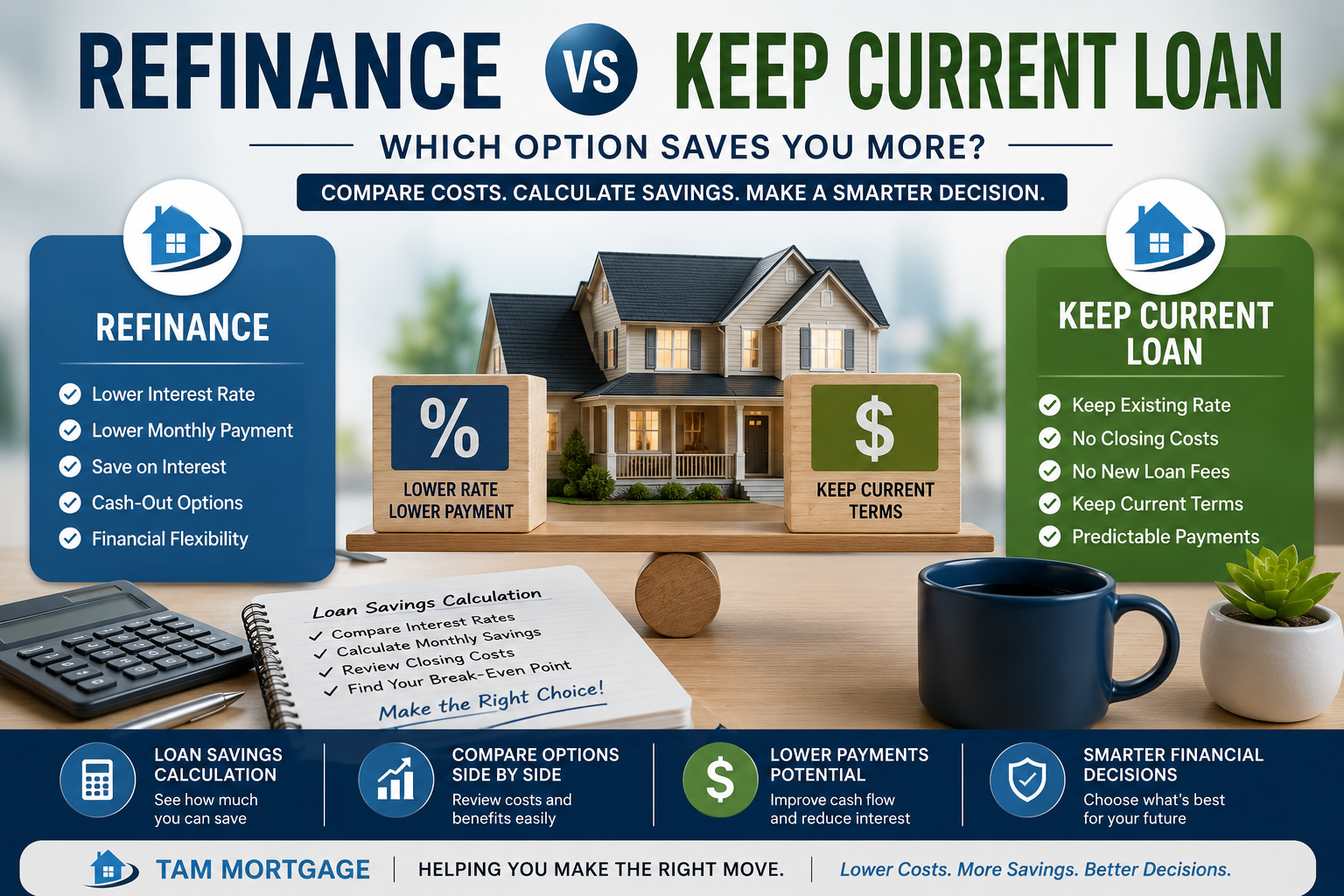
Every homeowner eventually faces the same question: should I refinance my mortgage or stick with what I have? With interest rates shifting and financial goals evolving, this decision is rarely straightforward. Refinancing can unlock meaningful savings — but it can also cost more than it’s worth if the timing or circumstances aren’t right.
This guide walks you through the key factors behind the refinance vs keep loan decision: upfront costs, monthly payment savings, the all-important break-even point, and the long-term financial impact — so you can make a confident, informed choice.
What Does Refinancing a Loan Mean?
Refinancing means replacing your existing mortgage with a new one, typically to achieve a specific financial goal. The most common reasons homeowners refinance include securing a lower interest rate, reducing monthly payments, shortening the loan term, or accessing home equity through a cash-out refinance.
There are several types of refinancing to be aware of:
Rate-and-term refinance is the most common — you keep the same loan balance but change your interest rate, loan term, or both. Cash-out refinance lets you borrow more than you owe and receive the difference in cash, useful for home renovations or paying off high-interest debt. FHA streamline refinance is a simplified option for existing FHA loan holders with fewer documentation requirements. VA refinance (IRRRL) offers a streamlined path for veterans wanting to lower their rate on an existing VA loan.
When Keeping Your Current Loan May Make More Sense
Refinancing isn’t always the right call. There are situations where holding onto your existing mortgage is clearly the smarter financial move.
If your current rate is already competitive — say, locked in during a low-rate period — refinancing could actually cost you more in total interest, especially if you restart a 30-year term. Similarly, if you’re planning to sell your home within the next few years, you likely won’t stay long enough to recoup closing costs through monthly savings.
Here’s a scenario that surprises many homeowners: if you’re already 15 years into a 30-year mortgage and you refinance into a new 30-year loan, you’re extending your debt by 15 years — even if your monthly payment drops. That extra time means more total interest paid, potentially wiping out any short-term savings.
Other situations where keeping your loan makes sense include having minimal monthly savings after refinancing, facing high closing costs relative to your loan balance, or already being close to payoff.
Refinance vs Keep Loan — Key Factors to Compare
Before making any decision, it helps to evaluate these five variables side by side.
Interest Rate Difference
As a general rule, refinancing becomes worth considering when the new rate is at least 0.5% to 1% lower than your current rate. A smaller difference may not generate enough savings to justify closing costs, particularly on shorter remaining loan terms.
Monthly Payment Savings
The most visible benefit of refinancing is a lower monthly payment. However, a lower payment doesn’t automatically mean you’re saving money — it depends on how much you owe and how long you’ll stay in the home.
Remaining Loan Term
Restarting a 30-year mortgage resets your amortization schedule, meaning your early payments go mostly toward interest rather than principal. If you have 10–15 years left on your current loan, refinancing into a new 30-year term could cost significantly more in total interest, even at a lower rate.
Closing Costs
Refinancing isn’t free. Expect to pay 2%–5% of the loan amount in closing costs, which typically include appraisal fees, origination fees, title insurance, and applicable taxes. On a $400,000 loan, that’s $8,000–$20,000 out of pocket.
Break-Even Point
The break-even point tells you how many months it takes for your monthly savings to offset what you paid in closing costs. Divide total closing costs by your monthly savings to find this number. If you break even in Month 36 but plan to move in Month 24, the refinance doesn’t pay off.
Loan Savings Calculation — How to Know if Refinancing Helps
Numbers make this decision clearer. Here are two practical examples.
Example 1 — Refinancing Makes Sense: A homeowner has a $400,000 remaining balance at 7.2% with 25 years left. A refinance at 5.9% on the same term reduces the monthly payment by roughly $340. With $10,000 in closing costs, the break-even point is about 29 months. If they plan to stay in the home for 10+ more years, refinancing saves tens of thousands in interest.
Example 2 — Refinancing Doesn’t Make Sense: A homeowner plans to sell in two years and would spend $9,000 in closing costs to save $180 per month. Their break-even point is 50 months — far beyond their timeline. Refinancing here is a losing proposition.
Using a mortgage refinance calculator makes it easy to plug in your numbers and see estimated payment changes, total interest savings, and break-even timelines before you ever talk to a lender.
Refinance Benefits Comparison
Here’s a quick side-by-side view of the key differences:
Factor | Refinance Loan | Keep Current Loan |
Monthly Payment | Potentially lower | Remains the same |
Interest Rate | May reduce | Fixed at current rate |
Closing Costs | Required (2%–5%) | None |
Loan Term | Can restart | Continues existing term |
Cash Access | Possible with cash-out | Not available |
Long-Term Interest | Could increase or decrease | Predictable |
Signs Refinancing May Be a Good Idea
Refinancing tends to work in your favor when several conditions are met. If market rates have dropped significantly since you locked in your current loan, that’s the most obvious trigger. Other strong signals include needing to lower monthly payments to free up cash flow, wanting to remove Private Mortgage Insurance (PMI) as your equity has grown, or having improved your credit score to a tier that qualifies for better rates.
Switching from an adjustable-rate mortgage (ARM) to a fixed-rate loan is another common reason — especially when rates are expected to rise and you want predictability. Cash-out refinancing can also make sense when you need funds for high-ROI home improvements or consolidating high-interest debt.
Signs You Should Keep Your Existing Loan
Staying put with your current loan makes sense if you’re planning to sell within the next two to three years, since you won’t have enough time to recoup closing costs. If your current interest rate is already near market lows, there may be little benefit to refinancing at all.
You should also think carefully if your monthly savings would be minimal — under $100 in many cases — or if you’re already in the final years of your loan. Paying closing costs to save a little on a loan you’re nearly done repaying rarely adds up.
Questions to Ask Before Refinancing
Before moving forward, get honest answers to these questions:
- How long will you stay in the home? If it’s less than your break-even timeline, the numbers don’t work.
- What are total refinance costs? Get a detailed Loan Estimate to see all fees.
- What is the break-even timeline? Monthly savings ÷ closing costs = months to break even.
- Will total interest increase? Restarting a long term can cost more over the life of the loan.
- Does refinancing align with your financial goals? Lower payment, shorter term, and cash access are different objectives that require different approaches.
How TAM Mortgage Can Help Homeowners Compare Options
Deciding between refinancing and keeping your current loan is easier with expert guidance. TAM Mortgage works with homeowners to review their current loan structure, estimate refinance savings, and calculate break-even points based on real numbers — not estimates.
Their team can walk you through available mortgage programs, compare long-term financial impact across different scenarios, and help you determine whether now is the right time to refinance or whether holding your current loan makes more financial sense.
Conclusion
Refinancing can be a powerful financial tool — but it’s not a guaranteed win. The right decision depends on how much rates have changed, how long you plan to stay in your home, what closing costs look like, and whether the monthly savings justify restarting your loan term.
Monthly payment reduction, total interest paid, and remaining time in the home are the three pillars of this decision. Run the numbers carefully before committing.
Thinking about refinancing? Contact TAM Mortgage to compare your current loan with available refinance options and calculate your potential savings before making a decision.