
Salaried vs Self-Employed: Who Gets Home Loans Easier?
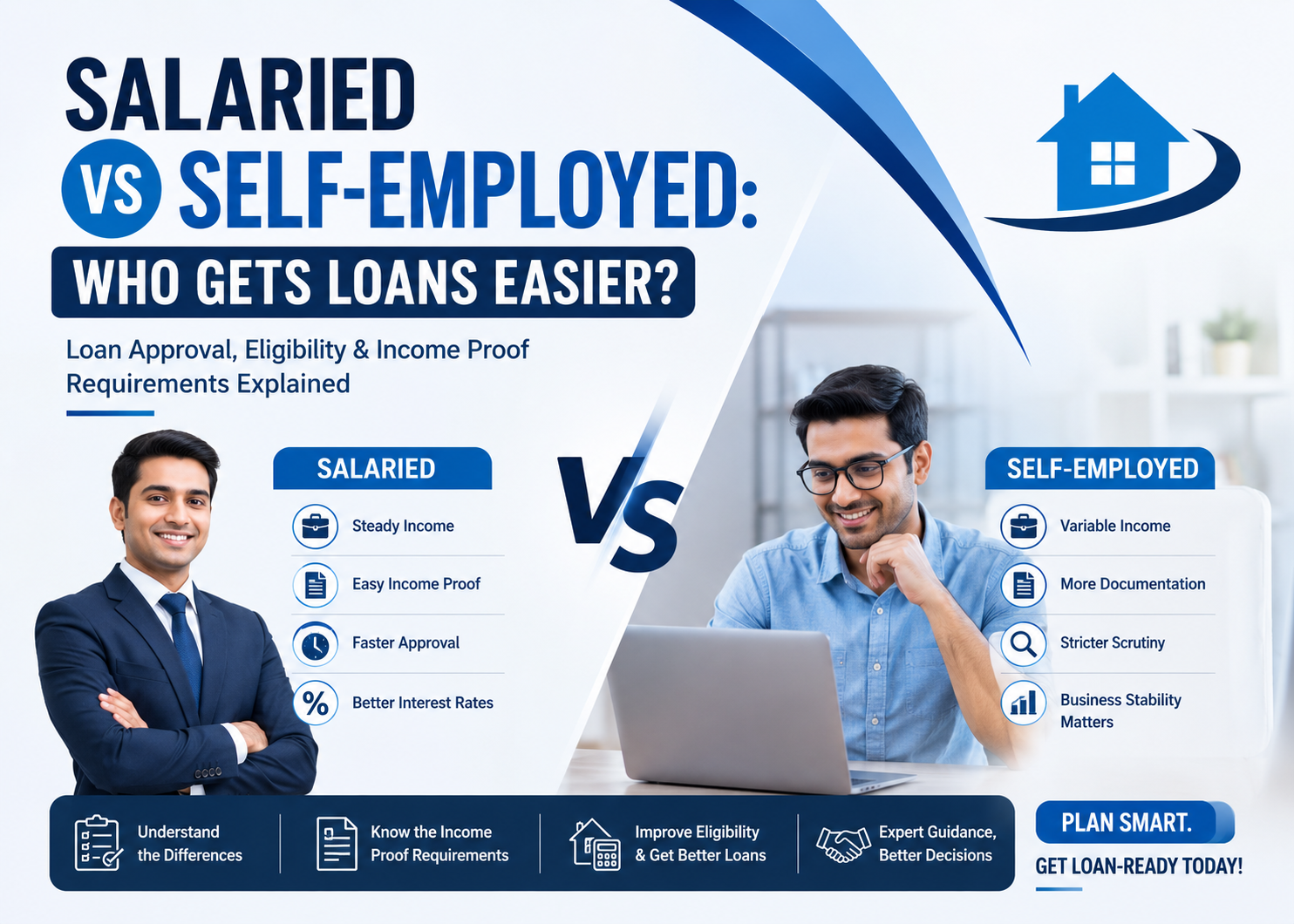
Dreaming of owning a home is universal — but the path to mortgage approval looks very different depending on how you earn your income.
When lenders evaluate a salaried vs self-employed loan application, they’re asking one fundamental question: How confident are we that this borrower will make their monthly payment? For salaried employees, that answer is often straightforward. For self-employed borrowers, it requires a closer look. Understanding how lenders think — and what you can do to strengthen your profile — can be the difference between approval and rejection.
How Home Loan Approval Works
Key Factors Lenders Evaluate
Regardless of employment type, every mortgage application is assessed on the same core pillars:
- Income stability — Can you sustain regular payments over 15–30 years?
- Credit score — Does your repayment history inspire confidence?
- Debt-to-income (DTI) ratio — How much of your income already goes to debt?
- Employment history — Have you maintained consistent, verifiable work?
- Existing liabilities — Outstanding loans, credit card balances, and obligations.
Why Employment Type Matters
Lenders price risk. A salaried employee offers predictable, verifiable monthly income — easy to confirm with a pay stub. A self-employed borrower may earn twice as much, but variable revenue and business expenses introduce complexity. This is why income proof requirements differ significantly between the two groups, and why processing timelines and rates may vary.
Home Loans for Salaried Individuals
Why Salaried Borrowers Often Get Easier Approval
Salaried applicants have one compelling advantage: consistency. A fixed monthly paycheck is simple to verify, simple to forecast, and simple for underwriters to approve. This predictability typically translates to faster processing, fewer documentation requests, and — in many cases — slightly more favorable interest rate offers.
Documents Required for Salaried Applicants
- Recent salary slips (last 2–3 months)
- Bank statements (last 3–6 months)
- Form 16 / W-2 or equivalent tax forms
- Employment verification letter from employer
- Government-issued ID and proof of address
Advantages for Salaried Applicants
- Faster loan processing with fewer back-and-forth documentation requests
- Lower paperwork burden overall
- Higher likelihood of qualifying for promotional or low-rate mortgage products
- Easier approval for high loan-to-value (LTV) ratios
Home Loans for Self-Employed Individuals
Being self-employed doesn’t disqualify you from getting a great mortgage — but it does mean you’ll need to be more prepared. If you’re a freelancer, business owner, contractor, or gig worker, a self-employed loan is specifically designed to account for how your income is structured.
Why Self-Employed Borrowers Face More Scrutiny
The challenge for self-employed applicants isn’t income — it’s proving that income in a way lenders accept. Variable monthly deposits, business deductions that reduce taxable income, and occasional slow seasons can all make a strong earner look risky on paper. Lenders assess both personal and business finances, which adds layers to the review process.
Income Proof Requirements for Self-Employed Borrowers
- Two years of personal and business income tax returns
- Profit & loss (P&L) statements (often CPA-prepared)
- Business and personal bank statements (12–24 months)
- Business license or registration documents
- GST records or equivalent business filings (where applicable)
- Letters from accountants or clients confirming ongoing work
Pro Tip: Lenders typically use your average net income over two years — not your gross revenue. If you’ve aggressively deducted business expenses to reduce taxes, that lower taxable income could reduce your eligible loan amount. Work with a mortgage professional to understand exactly how your income will be calculated before applying.
Common Challenges Self-Employed Applicants Face
- Declared income lower than actual earnings due to legitimate deductions
- Irregular deposit patterns that raise flags during bank statement reviews
- Difficulty showing business stability during the first 1–2 years
- Large year-to-year income fluctuations in early business stages
Salaried vs Self-Employed Loan Approval: A Direct Comparison
Factor | Salaried | Self-Employed |
Approval Speed | ✔ Faster (1–3 weeks typical) | ⚠ Longer (3–6 weeks or more) |
Documentation | ✔ Light (pay stubs, W-2, bank statements) | ⚠ Extensive (tax returns, P&L, bank statements) |
Income Verification | ✔ Simple and standardized | ⚠ Complex — averages across 2 years |
Interest Rate Risk | ✔ Lower risk profile | ⚠ Slightly higher without strong profile |
Loan Eligibility | Based on gross monthly salary | Based on average net income (2 years) |
Credit Score Impact | Critical for both — 700+ recommended | |
Home Loan Eligibility for Self-Employed Borrowers
Minimum Business Vintage Requirements
Most lenders require a self-employed borrower to have been in business for at least two years, with some preferring three or more. This continuity demonstrates that your income stream is established and not speculative. If you recently transitioned from salaried employment to self-employment in the same field, some lenders may be more flexible.
Improving Your Eligibility as a Business Owner
- File taxes every year without fail — gaps in tax history are major red flags.
- Maintain audited or CPA-reviewed financial statements for credibility.
- Reduce outstanding business and personal debt to lower your DTI ratio.
- Show consistent or growing income across both tax years — a drop in year two can hurt.
- Separate personal and business bank accounts to avoid commingled funds confusing underwriters.
How Salaried Applicants Can Improve Approval Chances
Salaried applicants start from an advantageous position, but there’s still room to strengthen an application:
- Maintain stable employment — avoid changing jobs in the 6–12 months before applying.
- Avoid frequent employer changes — a consistent employment record signals reliability.
- Keep credit utilization below 30% to maximize your credit score impact.
- Increase your down payment — 20% or more removes private mortgage insurance (PMI) and strengthens your application.
Which Borrower Type Gets Better Interest Rates?
Risk-Based Pricing Explained
Mortgage rates are not set arbitrarily — they reflect how much risk a lender is taking on. A salaried borrower with a stable job, good credit, and a straightforward income history typically represents lower risk, and lenders price that accordingly with more competitive rates.
When Self-Employed Borrowers Can Secure Competitive Rates
Self-employed borrowers are not doomed to high rates. If you can demonstrate consistent two-year income, maintain a credit score above 720, offer a larger down payment, and keep your DTI below 43%, you can absolutely compete for the same rate tiers as salaried applicants. Working with a lender who specializes in self-employed loans — rather than a generalist bank — can make a significant difference in both rate and approval likelihood.
Tips for Self-Employed Borrowers to Get Easier Loan Approval
5 Actionable Steps Before You Apply
- Separate personal and business finances — Use dedicated business accounts and cards. Mixed finances confuse underwriters and can delay or derail approval.
- Maintain a strong banking history — Consistent, explainable deposits across 12–24 months of bank statements build the narrative of a stable business.
- File taxes on time and consistently — Two years of complete, filed tax returns are non-negotiable for most lenders.
- Pay down existing debt before applying — Every dollar of monthly debt obligation reduces your eligible loan amount. Clear high-interest debt first.
- Work with specialized mortgage lenders — Visit TAM Mortgage to connect with professionals who understand how self-employed income is structured and how to present it effectively.
Common Mistakes That Lead to Loan Rejection
Whether salaried or self-employed, these mistakes can derail an otherwise strong application:
- Incomplete documentation — Missing one required document can pause underwriting for days or weeks.
- High debt-to-income ratio — Most lenders cap DTI at 43–45%. Know your number before applying.
- Poor credit history — Late payments, collections, or high utilization all reduce your attractiveness as a borrower.
- Unreported income — Income not reflected in tax returns typically cannot be used to qualify. Avoid this trap by filing accurately.
- Large unexplained transactions — A sudden large deposit without a clear, documented source (gift letter, asset sale, etc.) will trigger lender scrutiny.
Salaried vs Self-Employed: Who Really Has the Advantage?
When Salaried Borrowers Have an Edge
Salaried applicants have a clear advantage in speed and simplicity. If you need to close quickly, have a straightforward income history, and want the least complicated application process, being salaried works in your favor — especially for high LTV loans and first-time buyer programs.
When Self-Employed Borrowers Can Qualify Just as Easily
Self-employed applicants who have maintained clean financials for two or more years, carry strong credit scores, and have built meaningful equity or savings can qualify for the same loan products — often at competitive rates. The key difference is preparation time: self-employed borrowers benefit from planning their mortgage application 6–12 months in advance. Learn more about tailored options at TAM Mortgage’s self-employed loan page.
Financial Planning Matters for Both
Ultimately, a mortgage application is a snapshot of your financial health. Whether you receive a fixed paycheck or run your own business, the borrowers who succeed are those who maintain clean records, manage debt responsibly, and approach the process with preparation rather than urgency.
Ready to Find the Right Loan for You?
Whether you’re salaried or self-employed, our mortgage experts can help you find the right loan with faster approvals and competitive rates. Don’t let paperwork stand between you and your dream home.
considered good, while 740+ tends to unlock the most competitive interest rates. FHA loans may accept scores as low as 580 with a higher down payment, but conventional loans typically require 620 or higher.
This content is for informational purposes only and does not constitute financial or legal advice. Loan terms, requirements, and rates vary by lender and individual borrower profile. Please consult a licensed mortgage professional at TAM Mortgage for guidance specific to your situation.
FAQs
Does refinancing hurt your credit score?
Refinancing triggers a hard credit inquiry, which can lower your score by a few points temporarily. If you rate-shop multiple lenders within a 14–45 day window, most scoring models count all those inquiries as a single event.
How much equity do I need to refinance?
Most lenders require at least 20% equity for a standard refinance (80% LTV). For a cash-out refinance, most lenders limit the new loan to 80% of the home's value, though VA loans allow up to 100%.
Can I refinance with bad credit?
It's harder but not impossible. FHA streamline refinances and VA IRRRLs have more flexible requirements. A lower credit score will generally mean a higher interest rate, which may reduce the benefit of refinancing.
How soon can I refinance after buying a home?
For conventional loans, there's typically no mandatory waiting period, though many lenders prefer you've had the loan for at least 6 months. FHA and VA streamline refinances usually require a minimum of 6–12 months of on-time payments.
Can I refinance if I'm underwater (owe more than the home is worth)?
Standard refinancing requires equity. However, the High LTV Refinance Option (from Fannie Mae) and the Enhanced Relief Refinance (from Freddie Mac) may be available for underwater borrowers with on-time payment histories.