
VA Loan vs Conventional Loan: Key Differences Explained
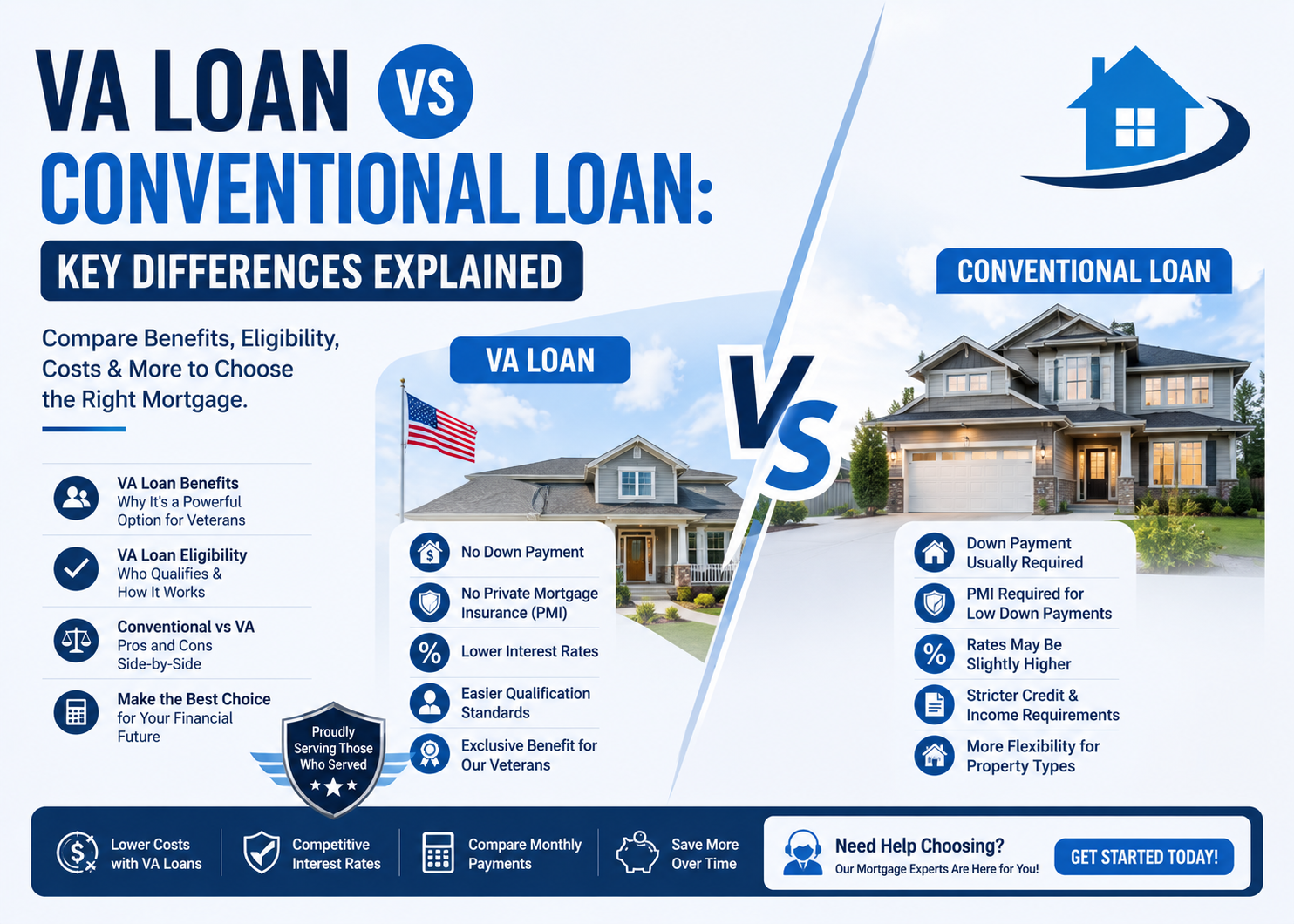
If you’ve served your country, you may have access to one of the most powerful mortgage benefits available — and most eligible borrowers don’t fully understand what they’re leaving on the table.
Choosing between a VA vs conventional loan is one of the most consequential financial decisions a veteran or active-duty service member will make. Both loan types can help you purchase a home, but they work very differently — in terms of who qualifies, how much you pay upfront, and what you spend over the life of the loan. This guide breaks down every key difference so you can make the right call with confidence.
What Is a VA Loan?
A VA loan is a government-backed mortgage program administered by the U.S. Department of Veterans Affairs and issued through approved private lenders. The VA doesn’t lend money directly — instead, it guarantees a portion of the loan, which reduces risk for lenders and allows them to offer more favorable terms to eligible borrowers.
VA Loan Eligibility Requirements
To qualify for VA loan benefits, you generally must be one of the following:
- An active-duty service member (typically 90 continuous days of service)
- A veteran who meets minimum service length requirements
- A National Guard or Reserve member (usually 6 years of service)
- An eligible surviving spouse of a veteran who died in service or from a service-related condition
Eligibility is confirmed through a Certificate of Eligibility (COE), which your lender can often obtain on your behalf. Beyond service requirements, lenders also assess income stability, credit history, and occupancy intent — VA loans are restricted to primary residences only.
What Is a Conventional Loan?
A conventional loan is any mortgage not backed by a federal government agency. These loans are issued by private lenders — banks, credit unions, and mortgage companies — and typically follow guidelines set by Fannie Mae or Freddie Mac for conforming loans. Non-conforming loans (including jumbo loans) exist for higher-value properties that exceed standard limits.
Conventional loans are the most widely used mortgage product in the U.S. and are available to any qualified borrower — including first-time buyers, move-up buyers, and real estate investors purchasing second homes or rental properties.
VA vs Conventional Loan: Major Differences
Factor | VA Loan | Conventional Loan |
Down Payment | 0% required | 3%–20% typically required |
Private Mortgage Insurance | None | Required if <20% down |
Credit Score | Flexible (often 580–620+) | 620 minimum; 740+ for best rates |
Interest Rates | Often lower due to gov. backing | Varies by credit profile |
Funding Fee | Yes (1.25%–3.3%) | None |
Property Types | Primary residence only | Primary, second home, investment |
Loan Limits | No limit for eligible borrowers | Conforming limit (~$766,550 in 2026) |
VA Loan Benefits Explained
No Down Payment
This is the headline benefit — and it’s significant. Eligible borrowers can purchase a home with zero down payment, preserving savings for moving costs, renovations, or an emergency fund. For a $400,000 home, that’s potentially $80,000 you don’t need to have in the bank before buying.
No Private Mortgage Insurance (PMI)
Conventional borrowers who put down less than 20% must pay PMI, which typically adds $100–$300 per month to mortgage payments. VA loans eliminate this cost entirely — a saving that compounds significantly over time.
Competitive Interest Rates
Because the VA guarantees a portion of each loan, lenders take on less risk — and they pass those savings to borrowers in the form of lower interest rates. Even a 0.25% rate advantage can save tens of thousands of dollars across a 30-year mortgage.
Easier Qualification Standards
VA loans tend to be more forgiving of past credit challenges. While lenders set their own minimum requirements, the VA’s backing allows many lenders to approve borrowers who wouldn’t qualify for a conventional mortgage at the same terms.
VA Funding Fee Note: VA loans do carry a one-time funding fee (typically 1.25%–3.3% of the loan amount, depending on down payment and prior usage). However, this fee can be rolled into the loan — and for most borrowers, the savings from no PMI and lower rates more than offset it over time. Veterans with service-related disabilities may be exempt entirely.
Conventional vs VA Pros and Cons
✔ Pros of VA Loans
- No down payment required
- No monthly PMI costs
- Typically lower interest rates
- More flexible credit requirements
- No prepayment penalties
✖ Cons of VA Loans
- One-time VA funding fee
- Primary residence use only
- Requires VA eligibility
- Property must meet VA standards
✔ Pros of Conventional Loans
- No eligibility restrictions
- Works for investment properties
- No funding fee
- PMI removable at 20% equity
✖ Cons of Conventional Loans
- Higher down payment typically required
- PMI adds monthly cost
- Stricter credit score requirements
- Generally higher rates for average-credit borrowers
Which Loan Is Better for First-Time Homebuyers?
For eligible military borrowers buying their first home, the VA loan is almost always the stronger starting point. The combination of no down payment, no PMI, and competitive rates creates a dramatically lower barrier to entry. A veteran purchasing a $350,000 home with a VA loan avoids both a $70,000 down payment (at 20%) and ongoing PMI costs — allowing homeownership years earlier than would otherwise be possible.
That said, conventional loans make more sense in specific scenarios: if you’re purchasing a second home or investment property (where VA loans don’t apply), if you’re a non-military borrower, or if you have strong enough credit and savings to put 20% down and prefer a clean loan structure without a funding fee.
Common Mistakes Borrowers Make: Watch Out For These
- Ignoring total loan costs — A lower interest rate doesn’t automatically mean lower total cost. Compare APR and all fees side by side.
- Choosing based only on rate — PMI, funding fees, and loan terms matter just as much as the headline rate.
- Not comparing multiple lenders — VA loan rates and fees vary between lenders. Shopping around can save thousands.
- Overlooking eligibility — Many veterans assume they don’t qualify or that their benefit is “used up.” In many cases, VA entitlement can be restored or used again.
Final Thoughts
When comparing a VA vs conventional loan, eligible veterans and service members should strongly consider leveraging their hard-earned VA benefits. No down payment, no PMI, and favorable interest rates are a powerful combination that can save tens of thousands of dollars over the life of a loan. Conventional loans remain a great option for non-eligible borrowers and for investment or vacation property purchases — but for primary home purchases, few loan products compete with what the VA program offers to those who qualify.
The right mortgage is ultimately the one that fits your financial goals, timeline, and eligibility. A trusted mortgage advisor can model both options side by side so you see exactly what each path costs — today and over time.
Explore Your VA Loan Benefits Today
Our mortgage experts will compare VA and conventional options side by side and help you find the loan that fits your financial future — with faster approvals and no pressure.
FAQs
Does refinancing hurt your credit score?
Refinancing triggers a hard credit inquiry, which can lower your score by a few points temporarily. If you rate-shop multiple lenders within a 14–45 day window, most scoring models count all those inquiries as a single event.
How much equity do I need to refinance?
Most lenders require at least 20% equity for a standard refinance (80% LTV). For a cash-out refinance, most lenders limit the new loan to 80% of the home's value, though VA loans allow up to 100%.
Can I refinance with bad credit?
It's harder but not impossible. FHA streamline refinances and VA IRRRLs have more flexible requirements. A lower credit score will generally mean a higher interest rate, which may reduce the benefit of refinancing.
How soon can I refinance after buying a home?
For conventional loans, there's typically no mandatory waiting period, though many lenders prefer you've had the loan for at least 6 months. FHA and VA streamline refinances usually require a minimum of 6–12 months of on-time payments.
Can I refinance if I'm underwater (owe more than the home is worth)?
Standard refinancing requires equity. However, the High LTV Refinance Option (from Fannie Mae) and the Enhanced Relief Refinance (from Freddie Mac) may be available for underwater borrowers with on-time payment histories.