
What Is Refinancing? (When Should You Do It?)
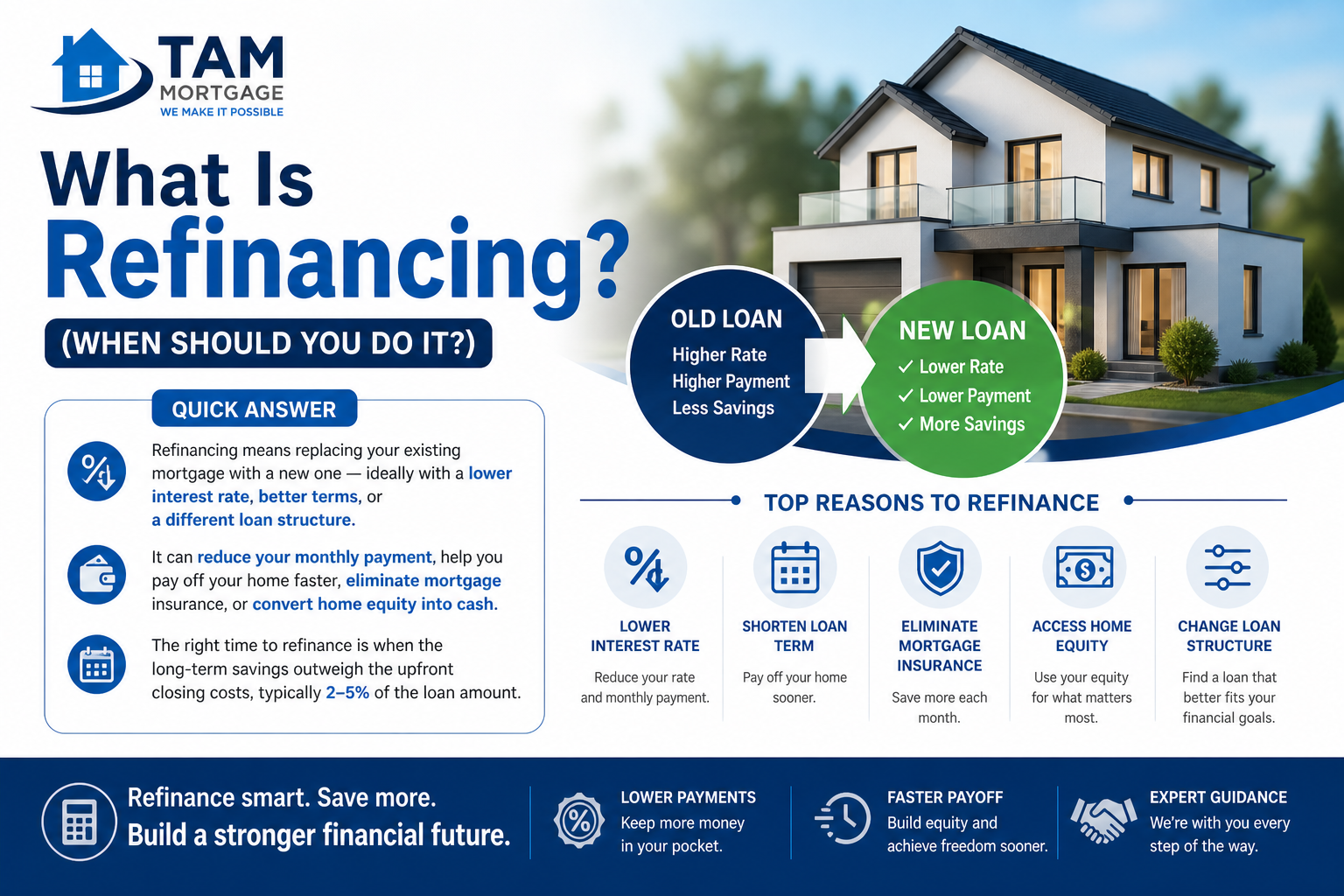
Refinancing means replacing your existing mortgage with a new one — ideally with a lower interest rate, better terms, or a different loan structure. It can reduce your monthly payment, help you pay off your home faster, eliminate mortgage insurance, or convert home equity into cash. The right time to refinance is when the long-term savings outweigh the upfront closing costs, typically 2–5% of the loan amount.
What Is Mortgage Refinancing?
Refinancing your mortgage means paying off your current home loan with a brand-new one. You’re not modifying your existing loan — you’re replacing it entirely with a new loan that (ideally) has better terms.
Homeowners refinance for a variety of reasons: to lock in a lower interest rate, to shorten or extend the loan term, to switch from an adjustable-rate to a fixed-rate mortgage, or to pull cash out of their home equity. Whatever the goal, the basic mechanics are the same — you apply for a new mortgage, go through underwriting, and if approved, your old loan is paid off and your new one begins.
Types of Mortgage Refinancing
Not all refinances work the same way. Choosing the right type depends entirely on your financial goal.
Rate-and-Term Refinance
The most common type. You replace your existing mortgage with one that has a lower interest rate, a different loan term, or both. No cash is taken out — the purpose is simply to improve your loan’s terms.
Best for: Homeowners who want to lower their monthly payment or pay off the loan faster.
Cash-Out Refinance
You refinance into a larger loan than what you currently owe and receive the difference in cash. For example, if your home is worth $400,000 and you owe $250,000, you could refinance for $300,000 and pocket $50,000 to use for home improvements, debt consolidation, or other expenses.
This cash out refinance is best for: Homeowners with significant equity who need funds for large expenses.
Cash-In Refinance
The opposite of a cash-out: you bring cash to the table at closing to reduce your loan balance. This can help you qualify for a better rate, eliminate PMI, or reach a lower loan-to-value ratio.
Best for: Homeowners who want better loan terms and have liquid savings available.
Streamline Refinance
A simplified refinancing option available to borrowers with FHA or VA loans. It requires less paperwork, may skip a full appraisal, and is designed to reduce your rate with minimal hassle.
Best for: FHA or VA loan holders looking to lower their rate quickly with fewer hurdles.
No-Closing-Cost Refinance
The lender rolls your closing costs into your loan balance or offsets them with a slightly higher interest rate. You avoid paying out of pocket, but you’ll pay more over time.
Best for: Homeowners who plan to move or refinance again within a few years.
When Should You Refinance? (6 Clear Signs)
Refinancing isn’t right for everyone at every moment. Here are the situations where it genuinely makes financial sense.
1. Interest Rates Have Dropped Significantly
The most common reason to refinance. If current rates are meaningfully lower than your existing rate, you can reduce your monthly payment and pay less interest over the life of the loan.
The general rule: For most homeowners, refinancing becomes worthwhile when rates drop at least 0.75 percentage points below their current rate. At that level, you can typically recoup closing costs within three years — the timeframe most financial experts recommend as a break-even benchmark.
A 1% or greater rate reduction is an even stronger signal. On a $350,000 loan at 7%, your monthly principal and interest payment is about $2,329. Refinancing to 5% would bring that down to roughly $1,899 — a savings of over $400 per month.
2. Your Credit Score Has Improved
If your credit score has risen significantly since you took out your original mortgage, you may now qualify for a better rate than you originally received. Lenders reserve their best rates for borrowers with scores of 740 or higher. If your score was in the low 600s when you bought your home and it’s now in the 700s, the rate difference can be substantial.
3. You Want to Switch Loan Types
Two common scenarios:
- ARM to fixed-rate: If you have an adjustable-rate mortgage (ARM) and the initial fixed period is ending, your rate is about to reset to market conditions — which could be higher. Refinancing into a fixed-rate loan locks in a predictable payment for the rest of the term.
- FHA to conventional: If you originally took out an FHA loan (which requires mortgage insurance for the life of the loan in most cases), and you’ve now built at least 20% equity, refinancing into a conventional loan can eliminate that insurance premium entirely.
4. You Want to Shorten Your Loan Term
Refinancing from a 30-year mortgage to a 15-year mortgage raises your monthly payment but dramatically cuts the total interest you pay. If your income has grown and you want to build equity faster and become debt-free sooner, shortening the term is a powerful strategy.
5. You Need to Access Home Equity
If you’ve built up significant equity in your home and need cash for a large expense — a major renovation, college tuition, or high-interest debt consolidation — a cash-out refinance lets you access that equity at mortgage interest rates, which are generally lower than personal loan or credit card rates.
6. You Need to Lower Your Monthly Payment (Financial Hardship)
If your budget is tight, you can refinance into a longer loan term to spread payments over more years and reduce your monthly obligation. Keep in mind this means paying more interest over time, but it can provide meaningful short-term relief.
When You Should NOT Refinance?
Refinancing isn’t always the right call. Here are situations where it likely doesn’t make sense:
You’re planning to move soon. If you sell before reaching the break-even point, you’ll lose money on the closing costs you paid. Calculate your break-even first (see below).
Your credit score has declined. A lower score since your original mortgage may mean you won’t qualify for a better rate. You could even end up with worse terms.
You’re close to paying off your loan. In the early years of a mortgage, most of your payment goes toward interest. By the later years, most goes toward principal. Restarting the clock with a new loan means paying interest all over again on a loan you’ve mostly paid down.
The closing costs are too high relative to your savings. If it’ll take 8 years to break even and you’re not sure you’ll stay that long, the math doesn’t work in your favor.
The Break-Even Point: The Most Important Calculation
Before refinancing, always calculate your break-even point. This tells you exactly how long it will take for your monthly savings to offset the upfront cost of refinancing.
Formula:
Break-Even Point = Total Closing Costs ÷ Monthly Savings
Example:
- Refinancing closing costs: $6,000
- Monthly savings from new lower rate: $239
- $6,000 ÷ $239 = ~25 months (just over 2 years)
If you plan to stay in the home longer than 25 months, refinancing makes financial sense. If you’re likely to move in 18 months, it doesn’t.
Closing costs on a refinance typically run 2–5% of the loan amount, and can include:
Cost | Typical Range |
Origination/lender fee | 0.5–1% of loan |
Appraisal fee | $300–$600 |
Title insurance | 0.5–1% of loan |
Credit report fee | $25–$50 |
Recording fees | $25–$250 |
Prepaid interest / escrow | Varies |
How the Refinancing Process Works? (Step by Step)
The refinancing process closely mirrors the original mortgage process, but is generally faster since you already own the home.
Step 1: Define your goal Are you lowering your rate? Accessing equity? Shortening the term? Your goal determines which type of refinance is right for you.
Step 2: Check your credit score and finances Review your credit report and calculate your current debt-to-income ratio. Lenders will evaluate these just as they did for your original mortgage.
Step 3: Shop multiple lenders Don’t assume your current lender has the best refinance rates. Get quotes from at least three lenders — banks, credit unions, and online lenders — and compare the APR (not just the interest rate) to account for all fees.
Step 4: Apply and submit documents Once you choose a lender, you’ll submit a formal application with documentation: pay stubs, W-2s, bank statements, tax returns, and proof of homeowners insurance.
Step 5: Home appraisal Your lender will order a new appraisal to confirm your home’s current market value. A higher appraised value can give you better terms and a lower loan-to-value ratio.
Step 6: Underwriting The lender verifies all documents, reviews the appraisal, and conducts a title search. Avoid any major financial changes during this period (new credit accounts, large purchases, job changes).
Step 7: Closing You sign the new loan documents and pay closing costs (unless rolling them into the loan). Your old mortgage is paid off and replaced by the new one.
Timing: The average refinance takes 30–45 days from application to closing, though streamline refinances can move faster.
Refinance Rate Rules of Thumb
Guideline | What It Means |
The 1% Rule | Refinancing is often worth it if you can lower your rate by 1% or more |
The 0.75% Threshold | For many homeowners, this is the minimum drop that justifies closing costs within ~3 years |
The 2% Rule (traditional) | An older rule of thumb — a 2% drop almost always makes refinancing worthwhile, though smaller drops can still be worth it with the right math |
The Break-Even Rule | Refinancing makes sense if you’ll stay in the home past the break-even point |
Note: These are starting points, not rigid rules. Always run the actual math for your specific loan amount, closing costs, and expected tenure.
Refinancing vs. Other Ways to Access Equity
If your primary goal is to tap home equity, a cash-out refinance isn’t your only option. Here’s how it compares:
Option | How It Works | Best For |
Cash-Out Refinance | Replace entire mortgage with a larger one | Large lump sum; also want to lower rate |
Home Equity Loan | Second mortgage, fixed lump sum | One-time large expense; want to keep existing rate |
HELOC | Revolving credit line secured by equity | Ongoing or variable expenses |
If your existing mortgage has a low rate you don’t want to lose, a home equity loan or HELOC often makes more sense than a cash-out refinance.
Refinancing Checklist: Are You Ready?
Before you start the process, make sure you can answer yes to these questions:
- My interest rate is at least 0.75–1% higher than current market rates
- I plan to stay in my home past the break-even point
- My credit score is 620 or higher (ideally 700+)
- I have enough equity (at least 20% for most refinances)
- My debt-to-income ratio is below 43%
- I can cover closing costs upfront (or accept the trade-offs of rolling them in)
- I’ve compared quotes from at least three lenders
Bottom Line
Refinancing is a powerful financial tool — but only when the numbers work in your favor. The core question is always: will the long-term savings exceed the upfront cost, within the time you plan to stay in the home?
The best time to refinance is when interest rates have fallen meaningfully below your current rate, your credit has improved, you want to change your loan structure, or you need to access home equity at a competitive rate. The worst time is when you’re close to moving, close to paying off your loan, or when closing costs exceed what you’ll realistically save.
Always calculate your break-even point, shop at least three lenders, and consult a licensed mortgage professional before making a final decision.
This article is for informational purposes only and does not constitute financial or legal advice. Mortgage terms, rates, and eligibility criteria vary by lender and may change. Consult a licensed mortgage professional for personalized guidance.
FAQs
Does refinancing hurt your credit score?
Refinancing triggers a hard credit inquiry, which can lower your score by a few points temporarily. If you rate-shop multiple lenders within a 14–45 day window, most scoring models count all those inquiries as a single event.
How much equity do I need to refinance?
Most lenders require at least 20% equity for a standard refinance (80% LTV). For a cash-out refinance, most lenders limit the new loan to 80% of the home's value, though VA loans allow up to 100%.
Can I refinance with bad credit?
It's harder but not impossible. FHA streamline refinances and VA IRRRLs have more flexible requirements. A lower credit score will generally mean a higher interest rate, which may reduce the benefit of refinancing.
How soon can I refinance after buying a home?
For conventional loans, there's typically no mandatory waiting period, though many lenders prefer you've had the loan for at least 6 months. FHA and VA streamline refinances usually require a minimum of 6–12 months of on-time payments.
Can I refinance if I'm underwater (owe more than the home is worth)?
Standard refinancing requires equity. However, the High LTV Refinance Option (from Fannie Mae) and the Enhanced Relief Refinance (from Freddie Mac) may be available for underwater borrowers with on-time payment histories.